Converting food waste is not a rubbish idea
Updated: 2012-01-30 09:57
By Diao Ying (China Daily)
|
|||||||||


 |
|
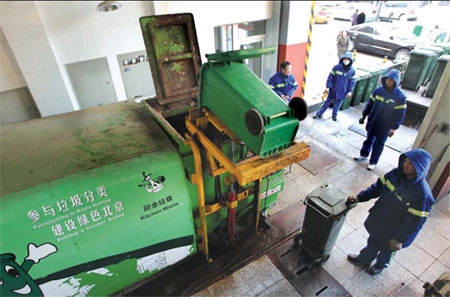
Sanitary workers put kitchen waste into a special garbage tank in a residential community in Beijing. Residents are encouraged to sort out their rubbish for recycling. [Photo / China Daily] |
Business value
In addition to the goodwill factor, Yu's business plan has the potential of producing profits. China generates about 1 billion tons of rubbish a year, 10 million tons of it cooking waste. The most common ways of disposal are to burn it or bury it. Neither way creates any business value.
Many rubbish treatment companies depend on government subsidies as their main source of income. Goldenway says it can ask for fewer subsidies because it can realize income through the sale of its fertilizers.
And the company obtains the raw materials almost for free, providing a competitive edge. Goldenway sells fertilizer through big State-owned companies, such as Sinochem Group, and directly to the government, which distributes it to rural areas.
Unlike most fertilizers used in China, Goldenway's fertilizer is organic, which can make the soil healthier. Zhang Hailiang works a strawberry field on a farm in Changping, northwest of Beijing. When he started, he said, the soil was almost barren. "It was so hard that our tools broke when we tried to turn the area into a strawberry field."
After three years, the soil has recovered its quality and now produces strawberries. "The farmers all know that the organic fertilizer is useful," Zhang said. "Some even fight for it."
Investors interested
Goldenway has just started to turn a profit, and financiers have seen its potential. The company received 167 million yuan ($26.4 million) from investors including Goldman Sachs in 2007. Tsing Capital, a venture capital firm that specializes in clean technology, invested $11.7 million two years later. Goldenway is preparing to seek a stock market listing next year.
Yu sees her company as doing well by doing good: By turning food waste into fertilizers, it will also cut the supply of oil processed from cooking waste.
Some people collect the waste, distill oil from it, and sell the oil to restaurants - hence, it is called waste oil. It also is called gutter oil, digouyou, because sometimes restaurants discard their used oil into the streets and sewers, and that oil too is reclaimed and sold. Its use in cooking is illegal, and a serious health risk.
Goldenway processed the cooking waste for the Olympic Village during the 2008 Beijing Olympics. It now has around 10 treatment factories in Beijing; others are being built. The company expects to expand the network to other cities in China as the government promotes the policy of rubbish classification.
Mo Jianguo, who runs a website for the cooking waste treatment industry, said more companies have entered the field but very few of them are profitable. Some are looking for quick money, he said, because clean energy and the environment are popular spheres for venture capitalists and private equity investors.
|
 |
|
Goldenway Bio-Tech's food waste treatment factory at Gao'antun, Beijing. [Photo / China Daily] |
2 big challenges
Mo said treatment companies face at least two problems. First, the government's policy on cooking waste is still not clear. "Restaurants can make money by selling their waste to illegal collectors, and they are not willing to give it out for free," he said. Each year, about 2 million to 3 million tons of gutter oil is reused.
This might be improving. In 2010, the State Council released a general guideline on the management of waste cooking oil, urging local governments to pay closer attention to the recycling of it. The Ministry of Public Security said in December that 700 people had been arrested on charges of collecting and manufacturing gutter oil since August. Other government agencies say they are working on standards to test the quality of cooking oil.
Sorting out waste is another problem. The classification of rubbish, a common practice in developed countries, is far from widespread in China. The government started experimenting in some key cities in 2000. In Beijing, for instance, some neighborhoods have barrels colored and labeled green for kitchen waste, blue for recyclables and black for other waste. But many households still put all their waste in the same plastic bag and throw it away.
"I know someone who said they just don't have enough space for so many barrels," Mo said. He said some companies try to generate electricity by burning waste, but when everything is mixed together, they sometimes cannot manage to burn.
Goldenway now collects mainly from companies assigned by the government. It hasn't yet tapped into individual families, a main source of cooking waste.
Write to the reporter at diaoying@chinadaily.com.cn
Related Stories
Govt to burn 40% of household waste 2011-09-02 07:57
Waste not, want not 2012-01-19 07:59
A magic pill for e-waste's ills? 2011-11-16 07:59
Construction waste surges as recycling stagnates 2011-10-20 20:18
- Real estate down under is very attractive
- Sino-US trade tensions may increase
- Surging new loans calls for another RRR cut
- Top auditor warns of fiscal, financial risks
- Call to adjust interest rates
- Real estate funds expected to rise
- Cadmium pollution contained in river
- Festival holiday boosts retail sales