 |
|
|
 |
|
|
|||||||||
|
 |
Oil prices and oil supply unambiguously tie China and the United States together, as both nations are heavy importers of oil. The United States imports about 65 percent of its oil and oil products, while China imports about 56 percent of its needs, which will undoubtedly increase over the next few years.
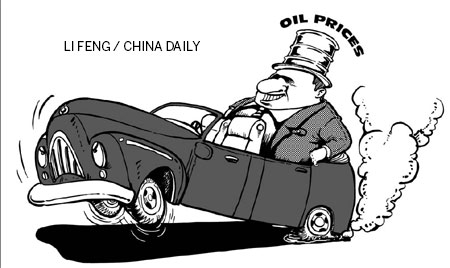
The rising trend in oil prices over the past three years has by no means been a classic recession response and the climbing price of crude oil may undo the US' fragile economic recovery and will certainly slow China's economic growth.
In response to the rising price of crude, the Chinese government recently raised the price of gasoline to 9,980 yuan ($1,584) per metric ton and the price of diesel to 9,130 per metric ton, the second rise in a year. In the US the price for regular gasoline has climbed to an historic $4 per gallon in at least six states, which translates to 8,700 yuan per metric ton. In many places diesel retails at a price equivalent to more than 9,500 yuan per metric ton. In the market-driven US these are unprecedented prices. There has even been some speculation that gasoline prices might soar to $5 per gallon by the end of the summer.
What is going on?
Geopolitics is what is going on. Geopolitics was the reason for the price of crude oil rising to $150 a barrel in 2008, and it is the reason prices are inexorably climbing toward a repeat of that figure unless something dramatic happens to defuse the situation in the Middle East, where the Iranian crisis is clearly the source of the current rise in oil prices.
The crisis with Iran is moving towards a climax, as Israel is making it increasingly clear it will act to stop Iran gaining nuclear weapons capability. Iran's neighbors in the Middle East are acting as though they believe confrontation is inevitable and are quickly revealing where their true loyalties lie and it isn't with Teheran.
Meanwhile, and this is very important, Iran's oil power is already declining.
Speaking at the biennial International Energy Forum conference in Kuwait in mid-March, the Saudi Arabian Minister of Petroleum and Mineral Resources Ali Al-Naimi offered this commitment over Iranian oil exports, Saudi Arabia and others remain poised to make good any shortfall, perceived or real, in crude oil supply.
It is clear that Shiite Iran does not actually have any real Sunni Arab friends.
OPEC is not likely to be cajoled into another 1973-style oil embargo should Iran be attacked. OPEC members understand well enough that such an action would more than likely trigger a political re-appraisal over energy in the West; one that would see Western public opinion swing behind fast-tracking the use of domestic shale gas and oil, where new technology, new discoveries and the high price of oil are making them increasing commercially viable.
According to the World Energy Council, there are 4.8 trillion barrels of proven global reserves of shale oil around a 150 years of oil at current usage rates and around 6 trillion barrels more of sand oil, although this includes both producible and non-producible oil.
And the threat to OPEC is not just from shale gas and oil, according to the World Energy Council there were around 1.2 trillion barrels of natural gas liquids and crude oil stood at in 2010, enough for around four decades at current usage.
But unfortunately for China, other than shale gas, almost all of this bonanza will be in foreign countries.
For China, politics aside, the path is obvious. Because the vast majority of oil goes to transportation in the form of gasoline, diesel and jet fuel, it must focus on developing alternative fuels. However, learning from the experience of developed countries, this must be done intelligently and avoid the wrong choices, such as corn-based ethanol which often has a negative energy balance and affects food prices in a highly undesirable way.
Infrastructure is a curse for the US but a blessing to China, this is because the US has trillions of dollars of existing infrastructure, while China is still developing its infrastructure. Meanwhile, there are 600 private vehicles per 1,000 people in the US, adding commercial vehicles rises to more than 1 vehicle per person. China has about 65 cars per 1,000 people. Clearly, China is a country where compressed natural gas, and methanol and ethanol cars, the last two from coal- or natural-gas-to-liquids processes, can be effectively developed.
Geopolitics are not going away anytime soon and oil prices will be at their mercy, China should concentrate on the full throttle development of alternative transport fuels.
The author is a professor at Cullen College of Engineering, University of Houston and editor-in-chief of Energy Tribune.