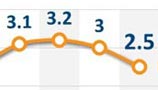
Wenzhou's nonperforming loan ratio is growing at a slower pace and is projected to reach its peak, according to the mayor of the city.
The latest development indicates that the private business hub in Zhejiang might be approaching the end of the aftershock from a local default and bad loan crisis that broke out more than two years ago.
"The bad loan ratio is still climbing but at a slower pace. I think it might reach its peak soon," Chen Jinbiao, mayor of Wenzhou, told China Daily.
After the crisis broke out, the central government in March 2012 granted Wenzhou the status of a "comprehensive financial reform pilot zone". Since then, Wenzhou has been regarded as a bellwether that would shed light on the reform path of the nation's private financing and investment regime.
|
 |
|
 |
Wenzhou local government has rolled out a series of initiatives aimed at exposing the previous underground lending system to "sunlight", which means putting it under a legal framework. Efforts include establishing a private lending management ordinance that has just been approved by Zhejiang's provincial legislature; the launch of a private-lending registration service center; and broader access to local government and central bank credit reference centers, which would facilitate the checking of borrowers' credit records.
Chen was candid about the difficulty of making substantial progress, saying the city was still reeling in the aftermath of the previous financial crisis and that private lenders with abundant cash were reluctant to lend their money, fearing a repeat of the previous scenario in which people ran away from their debts.
Many of the institutional changes that are badly needed are beyond the authority of the Wenzhou local government. Chen told China Daily in a previous interview that he hoped to see more endorsements from the central government, which include giving the coastal city pilot status to allow individuals to invest outwardly directly, granting the numerous small-sum loan companies "financial institution" status and making national laws to institutionalize the current private lending.
As a National People's Congress deputy of Zhejiang province, Chen this year submitted a motion calling for a national private lending law based on the just-approved provincial private lending ordinance.
For the city government's part, one major piece of progress, according to Chen, was the transferral under the government's direction of the previously scattered, small-scale private borrowings to registered commercial banks, which makes them much more transparent and more easily tracked.
Another move forward involved the previous massive number of small-scale private borrowings. Many were tangled in labyrinthine guarantee relationships but have been sorted out, and a much smaller number of major enterprises have become the guarantors, making it easier for the government to provide aid.
Moreover, Chint Group Corp and Huafeng Group Co Ltd, both Wenzhou-based private firms, were approved by the China Banking Regulatory Commission in mid-March to jointly establish a privately owned commercial bank. The approval is a "symbolic" move allowing cash-hungry small businesses to have more funding channels other than a handful of State-owned banks, according to Chen.
Zheng Jianjiang, president of Aux Group, an electrical appliance manufacturer in Zhejiang, and also a deputy of the NPC, made a suggestion that the nation should give the small-sum loan companies official financial institution status.
"The current small-sum loan companies are registered under the administrations for industry and commerce as nonfinancial companies.
This means that fraud and abuse of power by staff in small-sum loan companies could not be investigated for criminal responsibility, as happens in financial institutions," Zheng said.
Under the current regulation, small-sum loan companies can raise bank loans of no more than half of their registered capital, which greatly constrains their access to cash. The heavy turnover tax and corporate income tax levied on these companies make up a third of their profit, said Zheng.

Copyright 1995 - . All rights reserved. The content (including but not limited to text, photo, multimedia information, etc) published in this site belongs to China Daily Information Co (CDIC). Without written authorization from CDIC, such content shall not be republished or used in any form. Note: Browsers with 1024*768 or higher resolution are suggested for this site.
License for publishing multimedia online 0108263 Registration Number: 20100000002731