|
|
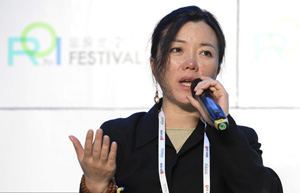
Han Jian, associate professor of management at CEIBS. PHOTO BY FENG YONGBIN/CHINA DAILY |
"Over the past two years you perhaps have a group of scholars who have started to move this way and to try and understand the unique aspects of Chinese management.
"Some Chinese management theory and practice might have Chinese tastes but I have not seen a theory that is totally Chinese. I also thought that about what the Japanese came up with in the 1980s. I think it added to the body of knowledge without actually changing it."
But what of the practitioners? Zhang Ruimin, who has turned Haier Group from being a loss-making, Qingdao-based, State-owned refrigerator manufacturer into the world's largest white good manufacturer in 30 years, is regarded as being one of China's leading entrepreneurs.
He believes that a company has to constantly adapt and innovate to stay ahead.
"One of the biggest differences is our ability to remake and overhaul ourselves. Many companies' ways of thinking and operating have ossified and become hard to change, especially their organizational structures," he told Strategy+Business, published by management consultants PwC last month.
"Those inside Haier, especially managers, understand that it's crucial that we adapt to the evolving needs of users and the changing market environment."
Zhang Ruimin, 65, says this fast-moving culture is still not true of many Chinese companies.
"At Chinese companies, it's exceptionally hard to remove an executive who is not performing well, especially if they're in the mid to high levels of management. At Haier, we can make fast changes. We have responded to the changing environment by eliminating or adjusting more than half of the vice-president-level executive positions."
Jack Ma, the 50-year-old former English teacher who has created perhaps China's most iconic company Alibaba, has his own management philosophy and says it is a mix of Taoism, Buddhism, Confucianism and tai chi.
"In Taoism, the best leadership is not leading at all. If someone warns me about an employee who is trying to overstep me, I reply that I'm a teacher and that's the way it should be," he said in an interview at Washington University.
Tse at Gao Feng says he is skeptical about those who bring Eastern philosophy into trying to understand how Chinese management differs from that of the West.
"When people talk about Chinese management, they often pick something from Confucius 2,000 years ago or some other ancient stuff. They talk about yin and yang and it is all almost cliched.
"There might be some elements of that are true. I am not disputing that. The crucial point, however, is that the China context has changed over the past five or 10 years and it is the fast-moving China environment that is forcing private business entrepreneurs into doing something different. This is what is underpinning the theories about a new Chinese approach to management."
Eric Thun, Peter Moores associate professor in Chinese business studies at Said Business School at Oxford University, is also not convinced when Oriental mysticism is brought in to discussions about management. "There is all this stuff that you can buy at airports about Confucius or Taoist approaches to management but I don't give too much credence to them," he says.
Like Williamson and Yin at Cambridge University, who believe there is something unique about Chinese management practice, Han Jian, associate professor of management at China Europe International Business School, is primarily focused on the management of innovation. She, however, believes that in the modern global context it is difficult to have a debate about differences between Western and Chinese management theories.
"I actually think in terms of management theory and best practice the national boundaries are actually blurring. It is difficult to say that this is typical of Chinese management practice and this other is something we learned from our neighboring countries. I'm not a believer that there is some new Chinese business model," she says.
Han, who is based at CEIBS Beijing campus and was speaking in a cafe in the Oriental Plaza in Wangfujing, one of China's most exclusive retail complexes, says there is an international pool of management ideas that those from individual countries can draw upon.
"I am not saying that the Chinese cannot contribute to this pool. I think they are doing this with their speed and flexibility and practices focused on market-driven customer value."
Johnson Chng, managing partner in Greater China at international management consultants AT Kearney, concedes there are some interesting management ideas coming out of China but he does not think they are making the breakthroughs some think.
"I think we are far from them becoming universal concepts. Whether or not one day we will open the Harvard Business Review and read about some Chinese company doing certain things that goes in a case study of business practice, I don't know. We are not there yet though."

Copyright 1995 - . All rights reserved. The content (including but not limited to text, photo, multimedia information, etc) published in this site belongs to China Daily Information Co (CDIC). Without written authorization from CDIC, such content shall not be republished or used in any form. Note: Browsers with 1024*768 or higher resolution are suggested for this site.
License for publishing multimedia online 0108263 Registration Number: 130349