Lured by low borrowing costs in Europe, a handful of Chinese companies have raised euro-denominated debt-but analysts warn that issuers' interest in such bonds may not last long.
Quantitative easing in Europe has driven rates to zero and below and weakened the euro. But it has also allowed companies to borrow more cheaply to finance buyout deals or refinance debt.
The Chinese borrowers have been State-owned enterprises. For example, Beijing Infrastructure Investment Co Ltd, which builds the capital's subways, was able to raise 500 million euros ($547 million) at a yield as low as 1 percent.
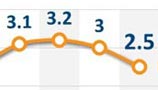
So far this year, Chinese mainland-based non-financial companies have sold 2.5 billion euros of debt, according to public information, compared with nothing in the first quarter of last year.
Before this year, only two Chinese companies had issued euro-denominated bonds. Since Jan 1, there have been four: BII, Baosteel Corp, State Grid Corp of China and China State Shipbuilding Corp. The latter three are central SOEs.
"We have quite a few big Chinese companies in our pipeline eager to sell euro-denominated bonds and inquiries into this new area are also increasing recently due to the dollar's strength," a Hong Kong-based banker at a Chinese financial institution told Reuters.
"Some of the companies that consulted with us on euro-denominated bond issues are thinking of acquiring assets in Europe, which are much cheaper now than before."
Issuers from China are highly rated by international agencies, which has led to favorable pricing for such bonds, said Christopher Lee, the Hong Kong-based managing director of corporate ratings at Standard & Poor's Financial Services LLC. Chinese issuers rated by the agency have been assigned ratings of at least A-.
"Low interest rates in the eurozone may appeal to issuers, but companies that have sold euro-denominated bonds are generally well known to investors and have funding needs in the euro," Lee said.
State Grid, a high-profile SOE, issued 700 million euros of seven-year notes and 300 million euros of 12-year notes. The order book was 2.25 billion euros, and the notes priced at 1.5 percent and 2.45 percent, respectively.
But most Chinese companies are still unknown to European investors, and they probably cannot achieve such terms.
It is also desirable for companies to have operations in Europe so the money they borrow can be spent locally. For example, State Grid owns stakes in grid operators in Portugal and Italy. BII does not have operations in Europe, but the funds flow back to China through its financial leasing company.
Companies should consider using swaps to hedge exchange-rate risk, Lee said. So far this year the euro has dropped 13.3 percent against the yuan.
Analysts said that euro-denominated debt may be just a passing phase.
The dollar remains the currency of choice for most Chinese companies seeking to raise offshore funds, and few Chinese companies have funding requirements in the euro or significant European operations. And big SOEs require approval from domestic regulators to raise offshore debt, which could limit the number of euro-denominated issues by such companies.
Lee said: "After two interest-rate cuts, onshore funding costs have also declined, making the domestic debt market attractive to Chinese companies."

Copyright 1995 - . All rights reserved. The content (including but not limited to text, photo, multimedia information, etc) published in this site belongs to China Daily Information Co (CDIC). Without written authorization from CDIC, such content shall not be republished or used in any form. Note: Browsers with 1024*768 or higher resolution are suggested for this site.
License for publishing multimedia online 0108263 Registration Number: 130349