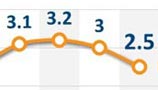
The People's Bank of China (PBOC) announced another 25 bps cut each in benchmark lending rate and deposit rate starting from Monday, bringing down the 1-year benchmark lending rate to 5.1 percent and 1-year benchmark deposit rate to 2.25 percent.
Meanwhile, PBOC also lifted the ceiling of deposit rate floating range from 1.3 times of benchmark rate to 1.5 times.
The move has been well anticipated by us and the market, against the backdrop of faltering real economic activity amid heightened deflationary pressures. Q1 GDP growth already slowed to post-2009 low and GDP deflator contracted by 1.1 percent year on year, and the upcoming April data may only show tentative stabilization.
The visible deterioration in nominal GDP growth stretches the economy's debt repayment capacity. This has been reflected in the high and rising real interest rate, which, in sharp contrast with flagging real economy, adds strains to the real economy, aggravating corporate and local government financial burden and leading to deterioration in banks' asset quality.
While the 65 bps rate combined cuts in benchmark lending rates last November and this March lowered banks' prime lending rate by 46 bps, UBS estimated broad weighted average financing costs dropped by only 15 bps in the same period, due to elevated money market rates in Q1 2015, which kept bill discount rates and bond yields high.
Moreover, while nominal financing costs dropped marginally, inflation came down more quickly in the same period, with average CPI and PPI in Q1 dropping by 110 bps from last Q4, and GDP deflator losing 150 bps.
Although the notable decline in money market rates and tentative rebound in inflation have led to a slight drop in real rates in April, we estimate real lending rates remained +110bps higher than the average of 2014 before today's rate cut.
Sunday's rate cut will not only directly lower interest rates, but also buttress inflation through both sentiment and demand channels. We thus expect real rate to come down further over the coming months, relieving debt service burden and improving corporate cash flow.
A well-anchored real rate can thus help support growth to stay within a "reasonable range" and contain financial risks. As we pointed out before, at current juncture, monetary easing is necessary to arrest passive tightening in monetary condition and to safeguard financial stability, though debt overhang, excess capacity and property's structural downshift would undermine its effectiveness in stimulating growth.
Raising the floating ceiling of deposit rate is another step forward in PBOC's interest rate liberalization plan, along with the recently enacted deposit insurance scheme.
Despite the lift of the ceiling, however, we do not expect most banks to fully utilize the range. Big state banks until this rate cut have only floated their deposit rate 10 percent above the benchmark instead of the full 30 percent, and medium & small sized banks 20-30 percent above the benchmark, for example. Such behavior will limit the squeeze on banks' net interest margin. Following the rate cut, we think large banks may keep their deposit rate largely unchanged from the current level.
In its latest monetary report, PBOC more clearly reiterated the easing bias of the monetary policy, highlighting the need of "appropriate adjustment according to economic situations", though ruled out the necessity of outright "quantitative easing" given the availability of other tools at hand and the structural issues and high leverage level. We thus expect further monetary easing via existing tools.
Looking ahead, we think at least another 25 bps rate cut, likely in Q3, is needed to bring real rates back to their 2014 average level. We also expect at least another 100bp RRR cut to help offset capital outflows and keep market interest rates low, further relaxation of renminbi loan quota and other credit restrictions, as well as expansion of pledged supplementary lending (PSL).
On the latter, PBOC's latest monetary report disclosed that 132 billion yuan of PSL has already been disbursed to the China Development Bank in Q1 2015, following the 383 billion yuan disbursement in 2014.
As the direct and effective funding support to infrastructure and shanty town renovation, we expect PSL to continue speeding up in Q2 and to exceed 1.5 trillion yuan in this year. As our current forecast has already penciled in all these policy easing measures, we maintain our 2015 GDP growth forecast of 6.8 percent, which implies a quarter on quarter sequential rebound in growth in Q2 and Q3.
The article is co-authored by UBS economists Wang Tao and Harrison Hu. The views do not necessarily reflect those of China Daily.

Copyright 1995 - . All rights reserved. The content (including but not limited to text, photo, multimedia information, etc) published in this site belongs to China Daily Information Co (CDIC). Without written authorization from CDIC, such content shall not be republished or used in any form. Note: Browsers with 1024*768 or higher resolution are suggested for this site.
License for publishing multimedia online 0108263 Registration Number: 130349