|
|
A clerk counts currency at a Bank of China Ltd branch in Nanchong, Sichuan province. [Photo/Xinhua] |
China will receive $66 billion this year in remittance inflows, according to World Bank projections.
The figure is almost three times what China received in 2005, which was $23.62 billion, based on the organization's estimates and International Monetary Fund balance of payments reported by the Chinese government.
Remittances, what immigrant workers send to their home countries, are a traditional means of financial support for family members left behind. With China being the fourth-largest source of immigrants and the most populous nation in the world, the numbers should come as no surprise. As the volume of overseas Chinese has increased, so has the flow of money returning to China.
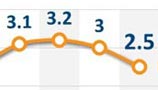
Dilip Ratha, lead economist in immigration and remittances at the World Bank, says: "Inflows (to China) increased sharply by 24 percent in 2008, followed by a dip by 13 percent in 2009. We expect to see an increase of remittance inflows to China by 3 percent to $66 billion in 2015, largely benefiting from continued US economic recovery."
The spike in 2008 may have a connection with the tragic events of May 12, when a 8.0-magnitude earthquake struck Wenchuan county in Sichuan province in southwestern China. Remittance inflows to China leapt from $38.39 billion in 2007, to $47.74 billion in 2008.
Ratha, in a 2013 report for the Migration Policy Institute, writes: "Unlike other monetary flows, remittances are counter-cyclical-family members abroad are likely to be even more motivated to give in times of hardship, even if their own financial situation has deteriorated as well. In this way, remittances are a form of insurance, helping families and communities weather external shocks."
Remittance can also be used to promote human and economic development, with these inflows sometimes paving the way for later trade and investment. Money sent by Chinese immigrants overseas served as important initial capital in the early stage of development in China's coastal areas, according to a 2012 United Nations document.
Professor Yu Zhu at Fujian Normal University says that sources of foreign investment in China closely related to the distribution of overseas Chinese and non-mainland Chinese originating from it.
In a 2012 paper for the UN Conference on Trade and Development, he writes: "Apart from Hong Kong, Taiwan and the Philippines ranked as the second and third most important sources of foreign investments for Jinjiang.
"This is closely related to the fact that there were a million Taiwan people with Jinjiang origins, and that 69 percent of the nearly 1 million overseas Chinese from Jinjiang or of Jinjiang origin were living in the Philippines.
"Similarly, Indonesia ranked as the second most important source of foreign investment for Fuqing, and this is closely related to the fact that among the 268,365 overseas Chinese who were from Fuqing or of Fuqing origin in the early 1990s, 73 percent of them were living in Indonesia."
Both Jinjiang and Fuqing are in southeastern China's Fujian province, once a primary source of emigrants.

Copyright 1995 - . All rights reserved. The content (including but not limited to text, photo, multimedia information, etc) published in this site belongs to China Daily Information Co (CDIC). Without written authorization from CDIC, such content shall not be republished or used in any form. Note: Browsers with 1024*768 or higher resolution are suggested for this site.
License for publishing multimedia online 0108263 Registration Number: 130349