 |
|
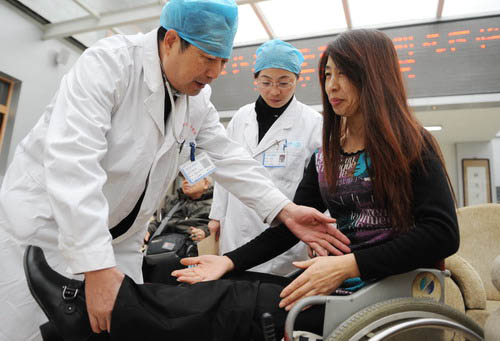
A doctor examines a patient at Beijing Wanshoukang Hospital.[Photo/China Daily] |
High networth individuals in Shanghai, particularly middle-aged ones, have a new motto: health is greater than wealth. They are actively planning for a post-retirement, health scare-free life.
According to a survey report released jointly by Beijing-based insurer Taikang Insurance and Hurun Report that documents the lives of the wealthy, 75 percent of Shanghai's rich people with a minimum personal wealth of 10 million yuan ($1.57 million) take a medical test every year.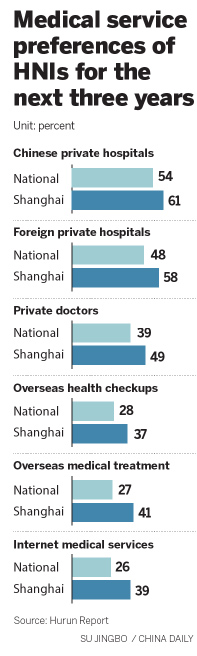
That is not all. About 12 percent of them subject themselves to a medical test every six months. While the majority still do so at domestic public hospitals or physical examination institutions, 20 percent of them choose domestic private hospitals.
And 17 percent go to foreign physical examination institutions in Shanghai. These figures are higher than the national average.
Li Zhiqi, 43, owner of an international trade company in Shanghai, goes to a foreign physical examination institution every year. Even though it charges five times or even more than the public hospitals, Li still prefers it as "it provides much better services".
"I am not saying that the services in public hospitals are not improving. Great progress has been made in recent years. But still, these hospitals have a huge stream of people every day. Foreign-funded physical examination centers usually have a smaller flow rate so that I can consult the doctor for a longer time and protect my privacy," he said.
The Taikang-Hurun survey studied 1,119 Chinese rich people, among whom 12.7 percent live in Shanghai. The city is home to the third-largest group of people with high net worth in the country.
The number of rich people with personal wealth of 10 million yuan and above grew by 22,000 this year to reach 181,000. Their total assets were worth about 20 percent of the total assets of the rich Chinese.
Private hospitals will be used the most by Shanghai's HNIs in future, according to the survey. About 61 percent of the respondents said Chinese-funded private hospitals will be their choice while some 58 percent also voted for foreign-funded ones.
Besides, half of the respondents polled said they will consult private doctors within the next three years.
And 61 percent of the interviewees think highly of private doctors because of the latter's ability to provide one-to-one health management plans. For as many as 43 percent of the respondents, availability of medical services is important.
"First and foremost, the medical market for high net worth individuals should follow the rule of accommodating as per patient's time. The tailor-made medical service should avoid disturbing the patient's work and life," said Pan Zhongying, president of Beijing United Family Hospital, China's largest foreign-funded healthcare provider.
The rich, it seems, not only take good care of their health at the present but make long-term plans. For instance, 160,000 HNIs in Shanghai have commercial life insurance for which they pay 6.1 billion yuan in annual premium, 15 percent of the national total.
China's rich are also quite interested in high-end nursing communities for the elderly. About 70 percent of the surveyed said they will study the current situation of these communities, and 45 percent expressed willingness to live in such communities in the future.
Younger HNIs' interest in such communities is high. Professional medical facilities, nursing staff, healthy food management, complete and regular medical checkups, cultural and entertainment activities should mark high-end nursing communities, according to those surveyed.
Sun Qixiang, director of the School of Economics at Peking University, said the growing number of senior citizens in China has created a huge demand for elderly care services as existing infrastructure is proving to be inadequate.
The problem can be resolved by "setting up more commercial nursing communities. In this way, old people can largely improve their life quality and service providers can make profits".

Copyright 1995 - . All rights reserved. The content (including but not limited to text, photo, multimedia information, etc) published in this site belongs to China Daily Information Co (CDIC). Without written authorization from CDIC, such content shall not be republished or used in any form. Note: Browsers with 1024*768 or higher resolution are suggested for this site.
License for publishing multimedia online 0108263 Registration Number: 130349