CHINA> Focus

|
CHINA> Focus
|
|
A pioneer in land-use rights reform
By Wang Zhuoqiong (China Daily)
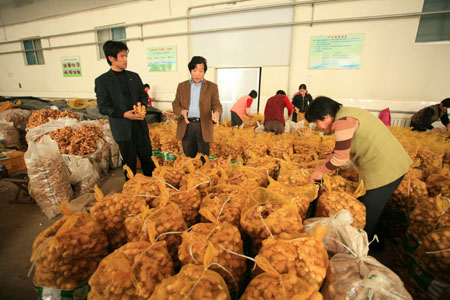
Updated: 2008-11-21 08:40 Li Changyou uproots a leafy plant with a ginger the size of a rugby ball. The ginger from the farm in Gongjiazhuang village, Shandong province, can soon land on the shelves of British supermarket giant Tesco and other supermarkets in European Union countries. The 44-year-old works for Laiwu Manhing Vegetables Fruits Corporation, which last year acquired the land-use rights of almost all the farmland in Li's village. Last month, the central government encouraged farmers to transfer their land-use rights to develop large-scale agriculture, improve efficiency, increase production and raise farmers' income - in short, raise the living standards of rural people.
"The land-use rights market has existed for many years," says Han Jun, director of the State Council Development Research Center's (DRC) rural economy department. "But only 5.68 percent of agricultural land has been transferred so far." That's why the new policy does not mean there'll be a rush across the country to transfer land-use rights. Nevertheless, the new policy is widely considered the most important since the establishment of the rural family household responsibility system in 1978.
The company, the country's second largest ginger exporter, however, began acquiring land from farmers in Gongjiazhuang and three other villages in Laiwu municipality a couple of years before the new policy was issued. Large-scale, standardized farming has enabled the company to not only increase output, but also lift its food safety level. Hence, its products are even exported to developed countries at prices 10 times higher than they would fetch in the domestic market. Gongjiazhuang, home to about 3,000 people, lies in a mountainous terrain, so development took time to reach it. It used to be a village of houses with weather-beaten tiled roofs and gray walls. Farmers either went to work in the fields, or migrated to cities, leaving a few women, elders and young children at home. The situation started changing about three years ago. Before Spring Festival in 2006, Gongjiazhuang was split into two camps: one-third of the families agreed to lease their land, with the rest being adamant not to because they doubted the fate of the deal. "It was very difficult," says Shen Yulu, 54, the village director, who began going from door to door to mobilize the villagers to lease out their land. "There was no precedent of large-scale transfer for the villagers." They had been growing ginger, garlic, corn and peanuts on their separate plots for years. That's why many of them were reluctant to transfer their land-use rights. "We had been farming all our life," Li says. "Farmers were worried whether the plan would work out. 'If you take our land away, what will we do?' they said." To allay the villagers' fear, the village committee stepped in as warrantor. "We told the reluctant villagers that 'if the company didn't pay, we had the right to call off the deal'," and that the 10-year lease would be reviewed annually, says Jia Chuanying, elected Party secretary of the village last year. To convince the adamant farmers, the company began a pilot project on 40 hectares of transferred land, using standardized farming, irrigation and natural fertilizers. "It was then that the reluctant farmers started changing their mindset," Liu Jianzeng, the company head, says. "They knew the small plots would never produce more money." |
|||||
主站蜘蛛池模板: 洛阳市| 怀集县| 尼勒克县| 铁岭市| 汉源县| 公主岭市| 同心县| 锡林浩特市| 花莲县| 黄大仙区| 泗阳县| 河间市| 晋中市| 毕节市| 兰考县| 观塘区| 中江县| 林州市| 阿克苏市| 贡觉县| 海兴县| 杨浦区| 米脂县| 海伦市| 咸丰县| 宁国市| 四川省| 德格县| 饶阳县| 满洲里市| 平乡县| 清苑县| 泾阳县| 冷水江市| 开平市| 宁城县| 河间市| 仁寿县| 曲松县| 讷河市| 疏附县| 雷波县| 固安县| 杭州市| 康马县| 中阳县| 洞头县| 修文县| 黔西县| 平遥县| 敖汉旗| 永城市| 马关县| 河津市| 平谷区| 金门县| 长子县| 青阳县| 肥西县| 望都县| 新津县| 台山市| 丹东市| 简阳市| 砚山县| 南汇区| 宣威市| 南康市| 黎平县| 鄄城县| 财经| 龙门县| 麟游县| 垦利县| 阜新| 仁化县| 炎陵县| 汽车| 日喀则市| 丰原市| 永平县| 女性|