Migrant workers prefer growing roots in cities
Updated: 2011-12-09 07:53
By He Dan (China Daily)
|
|||||||||||


BEIJING - Village life was losing its charm for the majority of young migrant workers, a survey showed.
Only about 4 percent of the new generation of migrant workers, or those who were born between 1980 and early 1990s, said they were willing to take up a job in agriculture, according to a survey released on Thursday.
|
 |
|
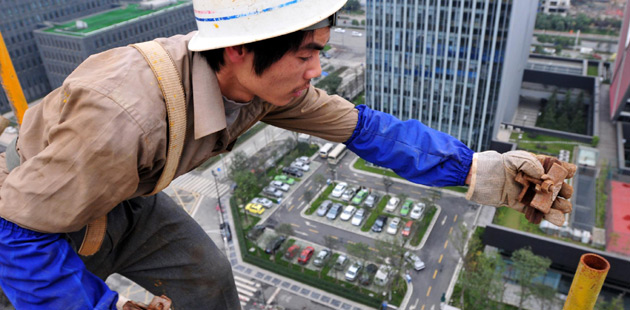
A migrant laborer who works as a cleaner stands on the ledge of a high-rise building in Shanghai's Pudong New Area on Aug 21. A recent survey finds that a very small number of young migrant workers are willing to go back home to a rural life. [Photo / Xinhua] |
The survey, in which more than 2,500 migrant workers from 20 to 31 years old were polled nationwide, was conducted by the Chinese Research Society of Family Culture, an institute affiliated to the All-China Women's Federation.
By contrast, nearly 38 percent of the respondents chose "starting new businesses" as their ideal occupation, and about 20 percent ticked "administrative staff" or "technician".
Settling down in cities was also the first choice for more than half of those polled. Noticeably, more women wish to move to the cities - 60 percent of female migrant workers said they wanted to stay in urban areas, some 5 percent higher than their male counterparts.
Only one out of eight polled said they planned to go back to their home village.
"I want to settle down in Beijing as it offers many opportunities for everyone," said Xiao Li, a waitress in a restaurant in the capital city.
The 23-year-old, from a poor rural family in East China's Jiangsu province, started working after graduating from a junior high school in order to support her two siblings to continue their schooling.
Chinese cities attracted about 230 million migrant workers, among whom about 85 million belonged to the generation born after 1980, according to figures published by the National Bureau of Statistics in 2009.
"Compared to the older generation, young migrant workers have less affection for the countryside and farmlands," said Hong Tianhui, vice-president of the All-China Women's Federation.
"Working and living in urban set-ups is their new dream."
The survey also indicates that young migrant workers frequently change their jobs and move to a new city once they are not happy with their situation.
On an average, the respondents have been spending about 4.7 years in urban areas, and roughly two thirds of the people surveyed have worked in two or more cities.
Nearly 80 percent changed their jobs once. The survey also found out that men tend to change their work more frequently than women. All the 1,137 male respondents changed their jobs about four times on an average, almost one more time than the women.
When asked about how they saw themselves in the next two years, more than 60 percent felt optimistic, while less than 2 percent foresaw a gloomy future if they were to continue living in cities.
Surplus labor moving from rural to urban areas is an inevitable process in China as the country's per capita arable land is among the lowest in the world, which creates little profits, says Zhou Tianyong, a professor of the Party School of the Communist Party of China Central Committee, on his Sina Weibo micro blog.
The fact that most educational and medical resources are located in cities also contributes to the migrant workers' preference for urban life, he says.
"Migrant workers should not be treated as cheap laborers, instead, the government should address their needs for development to create a harmonious society," said Jing Tiankui, former director of the Sociology Institute of the Chinese Academy of Social Sciences.
Duan Chengrong, a professor from school of sociology and population at Renmin University of China, believed that the government should prioritize expanding the coverage of social insurance network on migrant workers and ensure their children have equal access to education, being the top concerns of most migrant workers.
Related Stories
Young migrant workers not well adapted in city 2011-12-08 16:16
China raises $12m to help migrant workers 2011-12-04 21:51
Migrant children: I am a little swan 2011-11-29 17:20
Migrant workers get a taste of culture 2011-11-16 07:34







Hot Topics
HIV/AIDS, Egypt protest, Thanksgiving, climate change, global economic recovery, home prices, high-speed railways, school bus safety, Libya situation, Weekly photos
Editor's Picks

|

|

|

|

|

|

