|
|||||||||||


Distance learning may be cheaper alternative to large bus purchases
BEIJING - China should do more to develop distance education as part of the effort to reduce school bus accidents, a senior official said over the weekend.
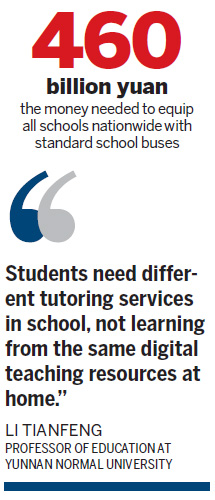
Some 460 billion yuan ($73 billion) is needed to equip all schools nationwide with standard school buses, Liu Yandong, a member of the Political Bureau of the Communist Party of China Central Committee, said at a meeting on education on Saturday.
|
 |
The estimate is based on a plan to cover all 150 million primary- and middle-school students at schools where attendance is compulsory, she said.
However, Liu said it's still difficult for the government to allocate so much money at once, and more effort should be made to develop distance education, which can free rural students from traveling long distances to receive a quality education.
In a move to promote distance education, 103 universities made a commitment on Saturday to open their digital educational resources to the public.
Fatal school bus accidents have made the headlines in recent months, and many people believe that these accidents are a result of the policy of dismantling small teaching sites and combining schools in rural regions.
According to the Ministry of Education, the number of primary schools decreased more than 50 percent from 1997 to 2009.
About 70 percent of the school bus accidents occurred in rural areas, according to previous research from the Sunglory Education Research Institute, a Beijing-based education service provider.
As one means to solve the distance problem, China began in 2002 to promote boarding schools.
However, teachers have found themselves under huge psychological pressure to take care of students who are too young to live at boarding schools independently.
"The local governments actively promote the policy of dismantling small teaching sites and combining schools in rural regions, because they want to reduce investment rather than improving teaching quality," said Xiong Bingqi, deputy director of the 21st Century Education Research Institute, a private, nonprofit policy-research body.
"Research should be launched into the policy of dismantling small teaching sites and combining schools in rural regions after it's been in place for 10 years," Kang Jian, a professor of education at Peking University, was quoted as saying by the China Youth Daily.
He noted that some local governments were making decisions on data that had been collected without practical research.
For example, the distance between some rural households and the nearest school might be only 2 or 3 km on the map, but the real travel distance could be 7 or 8 km when taking into account the rough and winding mountain roads, he said.
As for distance education, experts said it is still not a perfect solution.
"I don't think distance education is a good way to teach primary-school students," Li Tianfeng, professor of the faculty of education and management at Yunnan Normal University, told China Daily on Sunday.
"Students need different tutoring services in school, not learning from the same digital teaching resources at home," Li said.
"They also need to learn how to communicate with classmates at school", Li said.
"Distance education would be a new problem for parents who would have to stay home with their children," Li added
Some others also question how the figure of 460 billion yuan was arrived at.
"I hope officials learn how to control the cost," Ye Qing, the vice-director of the Hubei Statistics Bureau and deputy to the National People's Congress, said on his micro blog on Sunday.
"Not all 150 million Chinese students in primary and middle schools need school buses, and the priority should be to give students at rural schools" the necessary transportation, said Yuan Guilin, a member of the Chinese Society of Education.
Guo Anfei in Yunnan contributed to this story.


Hot Topics
HIV/AIDS, Egypt protest, Thanksgiving, climate change, global economic recovery, home prices, high-speed railways, school bus safety, Libya situation, Weekly photos
Editor's Picks

|

|

|

|

|

|

