Guidelines welcome foreign investment
Updated: 2011-12-30 07:46
By Ding Qingfen and Lan Lan (China Daily)
|
|||||||||


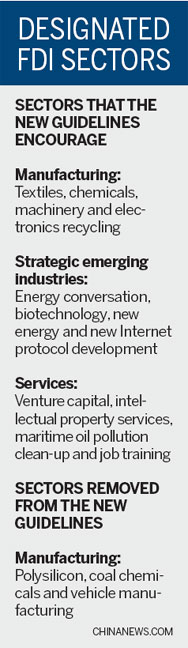
In the new guidelines, the Chinese government will encourage foreign enterprises to invest in new technology and equipment for the textile, chemicals and machinery-manufacturing industries.
The guidelines also call for the encouragement of investment into nine service industries. Among them are those concerned with charging electric vehicles and swapping their batteries, protecting intellectual property rights, cleaning up offshore oil pollution and vocational training.
China will also allow foreign companies to invest in medical institutes and various other industries that were previously off limits to them.
Dirk Moens, secretary general of the European Union Chamber of Commerce in China, said foreign investors are likely to take heed of the government's investment guidelines.
This "will indeed facilitate decision-making for foreign investors thinking of coming to China", Moens said.
Kong Linglong, director-general of the National Development and Reform Commission's department of foreign capital and overseas investment, had similar thoughts.
"Looking at the changes in the new version, we can tell the way in which the Chinese government would like to transform its industrial structure," Kong said.
|
 |
"And another message is that China is now placing more value on the quality of foreign investments rather than their scale."
The government will also prevent foreign companies from building or operating refineries that have the capacity to distill fewer than 200,000 barrels of crude oil a day. That is up from the previous limit of 160,000 barrels a day.
China, meanwhile, has removed industries from the list of those it encourages foreign companies to invest in. No longer part of that group are automakers, large coal-to-chemical operations and manufacturers of polycrystalline silicon.
"The restrictions generally apply to industries that have excessively large capacities and that pollute the environment," said Zhang Xiaoji, senior researcher at State Council's development research center.
"But they will probably be a source of their (foreign companies') complaints about transparency in China's market for foreign investment. To alleviate their concerns, China should try to provide detailed information about what will be restricted."
China issued the first version of its guidelines governing foreign direct investment in 1995. They are now amended every four years.
China released a draft version of the new guidelines in early April, seeking the public's suggestions and comments.
"We have made reasonable changes in response to foreign companies' opinions," Kong said. For instance, the draft version said foreign investors could take no more than a 50-percent stake in joint ventures that produce all of the chief components needed in new-energy vehicles, a proposal that led to heated discussions in the auto industry.
The final version changed the stipulation about "all chief components" to one that only concerns "fuel cell batteries".
Giving a keynote speech in December at a celebration ceremony for the 10th anniversary of China's entry into the World Trade Organization, President Hu Jintao said China will continuously open its economy to the world. He said that is especially true for industries concerned with advanced manufacturing, strategic emerging industries, services, agriculture and modern culture.
In April, China issued a directive that encouraged more investment in the high-tech, renewable energy and service industries, and for more attention to be paid to the country's western and central regions. The directive marked a turning point in China's policies concerning foreign direct investment.
China is now the second-largest destination for such investment in the world and the largest among developing economies. In 2010, the value of foreign direct investment into China hit a record high, increasing to $105.74 billion, a rise of 17.4 percent from the year before. In 2009, it decreased by 2.6 percent.
From January to November, the value of China's foreign direct investment increased by 13.15 percent from the same period the year before, reaching $103.77 billion.





Hot Topics
HIV/AIDS, Egypt protest, Thanksgiving, climate change, global economic recovery, home prices, high-speed railways, school bus safety, Libya situation, Weekly photos
Editor's Picks

|

|

|

|

|

|

