Strategic mutual trust and national feelings between China and Japan have been strained, and think tanks from both nations on Wednesday called for a crisis management mechanism to cool down the heated bilateral spats.
Tensions have escalated from a series of feuds over the Diaoyu Islands issue this year, since Tokyo Governor Shintaro Ishihara in April unleashed plans to "purchase" the islands, which belong to China.
After Beijing protested the Japanese rightists’ landing on the islands this month, Tsuyoshi Yamaguchi, Japan’s parliamentary senior vice-minister of foreign affairs, arrived in Beijing on Tuesday in an effort to ease tensions.
 |
|
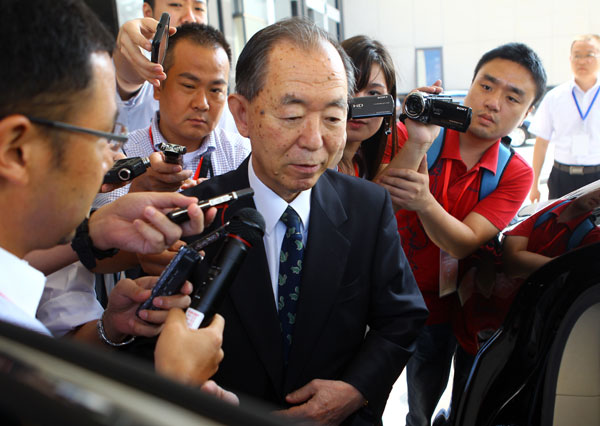
Uichiro Niwa, Japanese ambassador to China, is surrounded by reporters during a forum in Beijing on Wednesday. Zou Hong / China Daily |
Concerns emerged over polls that show Japanese nationals’ feelings toward China are becoming increasingly unfavorable during a seminar held by the Chinese Academy of Social Sciences in Beijing to commemorate the 40th anniversary of both countries normalizing diplomatic relations.
"China and Japan have seen rapid growth in bilateral trade, yet the political mutual trust remains far from ideal, and the region suffers from the absence of a regional security mechanism," said Yang Bojiang, a professor of Japanese studies at the University of International Relations in Beijing.
The turbulence between China and Japan has been aroused by new factors amid the reshuffled balance of power since 2000, and Japan is still obsessed with a Cold War mentality despite its enhanced internationalization, Yang said.
Kyoji Yanagisawa, former Japanese assistant deputy chief cabinet secretary, said the Cold War mentality, along with the zero-sum game mentality, escalates tensions, and the threats of potential major conflicts "cannot be simply wiped out" by economic interdependence on each other.
Japanese Prime Minister Yoshihiko Noda in early July announced his cabinet’s plans to "nationalize" the Diaoyu Islands, a move that prompted protests from Beijing.
Yanagisawa also criticized Noda’s lack of communication with Beijing following the protests.
Lu Yaodong, director of the department of Japanese diplomacy at the Institute of Japanese Studies of the Chinese Academy of Social Sciences, said both countries have seen frictions in political and security fields despite a deepening economic coexistence.
Lu warned that China-Japan ties might further deteriorate as the Diaoyu Islands issue remains a major headache.
Hideo Tarumi, minister of the Japanese embassy in China, called for a crisis management mechanism to ease tensions.
"We should not be afraid of the frictions between Japan and China and the current absence of the crisis management mechanism. What may haunt us is its breakdowns," Tarumi said.
Ties between China and Japan have been strained by Tokyo’s stance on the Diaoyu Islands since 2010, when a Chinese trawler captain was held by Japanese authorities for what Tokyo called "illegal fishing" off the islands.
Tarumi also hailed the tangible progress Japan and China have witnessed since the beginning of the year.
China and Japan in May held their first round of high-level consultations on maritime affairs in Hangzhou of eastern China’s Zhejiang province.
Officials from the two countries’ foreign and defense ministries, as well as their maritime affairs departments, attended the one-day meeting. The second round of talks is planned for the second half of the year, according to Xinhua News Agency.
Constant communication is also expected when there isn’t a crisis, and analysts called for more "restrained and responsible remarks" from key public figures.
Some prominent political figures in Japan, including Japanese Defense Minister Satoshi Morimoto, recently indicated the possibility of dispatching Japan’s Self-Defense Forces troops to handle the Diaoyu Islands issue "once the situation goes out of control".
The radical remarks have prompted public concerns from Japan’s neighbors over Tokyo’s military past and attempts to normalize its armed forces.
According to Yanagisawa, the government should "play a correct role in guiding public opinion" when implementing crisis management.
Yang suggested both sides clarify their counterpart’s role in the strategic blueprint.
Tarumi also urged Chinese and Japanese nationals to reshape their views of their counterparts.
Observers from both sides also suggested boosting public diplomacy and civil dialogue channels to diversify bilateral information updates.
"Reining in the crisis is just the short-term goal, and the long-term mission lies in propelling cultural exchanges between peoples," Yanagisawa said.
Experts also placed high expectations over the ability of both nations to effectively communicate with the public.
"Currently new media are rising, and the mass media are showing widespread poor control over the quality of their reports, a move that has misled the general public," Yang said.
"It is a major task for both China and Japan to cool down the over-stimulated nationalist mood, and the job requires wisdom," said Akio Takahara, a professor of contemporary Chinese politics at the University of Tokyo.
Contact the writers at zhangyunbi@chinadaily.com.cn and caihong@chinadaily.com.cn.


Copyright 1995 - . All rights reserved. The content (including but not limited to text, photo, multimedia information, etc) published in this site belongs to China Daily Information Co (CDIC). Without written authorization from CDIC, such content shall not be republished or used in any form. Note: Browsers with 1024*768 or higher resolution are suggested for this site.
License for publishing multimedia online 0108263 Registration Number: 130349