The MAO legacy
(China Daily)
Updated: 2011-08-01 17:50
 Comments()
  Print
Print  Mail
Mail  Large Medium Small
His memory is kept alive in various ways, including a huge portrait in Tian'anmen and many statues guarding important institutes of learning all across China. Li Jing finds out more about the genesis of the trend.
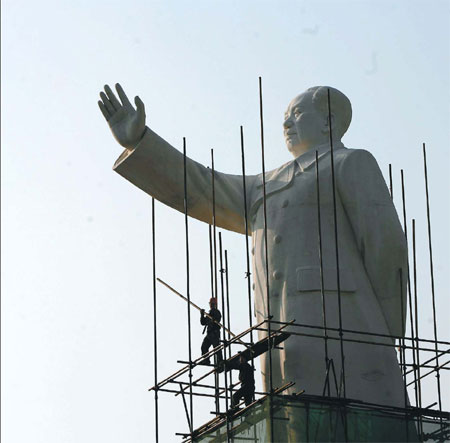
The year is 1967, and it is May 4, a day dedicated to the youths of China in memory of the first student revolution. At the second gate of Beijing's Tsinghua University, an inauguration ceremony is taking place to unveil a statue of Mao Zedong. The occasion would make headlines throughout China and trigger a countrywide trend that would see dozens of Mao statues erected throughout the 10 years of "cultural revolution" (1966-76).
But, the Tsinghua statue was not the first. The first statue outdoors erected in honor of the late Chinese leader was built in 1952, high on Mount Yamalike in the southwestern corner of Urumqi, the capital of Xinjiang Uygur autonomous region.
After the first rush that lasted until the late 70s, there was a lull in the enthusiastic homage until 2008, when a statue of Mao Zedong again made the news. This was the unveiling of a 20-meter high stainless steel monument at Chongqing Medical University, the tallest statue of the revolutionary leader.
"To set up statues of Mao Zedong has been a university campus tradition for decades," Beijing Morning Post quoted a spokesman as saying in the southwestern Chinese city. "The purpose of the statue is to encourage and give confidence to our teachers and instill national character and patriotism in our students."
At Tsinghua, where the tradition started, the original statue has become part of the University's landscape, and more.
"If we had set up the Mao statue earlier, no one would have dared pull down the original gate," 70-year-old Gao Luji recalls with regret, adding that the image would have been an insurance for the preservation of the Tsinghua landmark. He should know, since he was part of the team that built the new monument.
In 1967, Gao was a fresh civil engineering graduate from Tsinghua University and he was appointed to lead the project because of his artistic skills and his knowledge of concrete construction.
More than 30 sculptors from fine arts academies and other units were quickly assembled to work on the statue.
Among them was Zhang Songhe, a sculptor of legendary renown. In joining the project, he managed to escape the "revolutionary" turbulence during which artists were often given a hard time and interrogated. And, as a Communist Party member, he was handed the assignment of crafting the statue's face.
It was often dangerous work. Chen Shuguang, Zhang's wife, who also participated in many Mao's statue projects, said there were no safety harnesses. Zhang had to perch on 10-meter-high wooden scaffolding to reach the top and worked for several hours at a time from the lofty heights.
"If he had not served in the People's Liberation Army, he would not have endured it. He kept working through his sheer enthusiasm," Chen said.
After the Tsinghua statue was unveiled, there was a rush to learn how to construct similar statues. The Tsinghua team worked day and night to compile brochures which explained the process and the university's Department of Architecture formed a team to make molds to meet the surging demand.
On June 11 the same year, another Mao statue was put up at the Beijing PLA Political Institute, a copy of the Tsinghua original. After that, many copies of the Tsinghua model would be replicated all over the country, from Youyi County in Heilongjiang province to Duyun in the southwestern Guizhou province.
At Fudan University in Shanghai, the Mao statue has achieved a different attention.
The imposing memorial on its campus has some magical numbers, which the university termed the "3-figure" formula.
The height of the statue is 7.1 meters, commemorating the birth of the Communist Party of China on July 1. Its base is 5.16 meters tall, a reference to the "516 Announcement" drafted by Mao Zedong which set out the "guidelines for cultural revolution". If you added both sets of numbers together, their sum total came up to 12.26. Dec 26 is the date of Mao Zedong's birthday.
The formula captured the imagination of many, including the architects of Mao's statue in his hometown of Shaoshan, which also erected its own monument according to these magic numbers.
Video