BEIJING - The "made-in-China" label has been shedding its cheap image and reputation for low value-added goods as China takes over the United States to become the top powerhouse in global trade.
Factories in the world's second-largest economy are churning out ever more sophisticated products for people around the globe, the latest customs statistics showed.
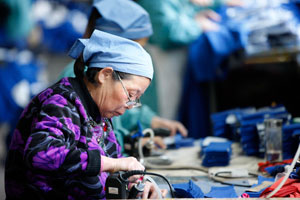
Machinery, electrical and high-tech products continued to expand their share of total exports with their growth rates outpacing those of other major items. In 2013, machinery, electrical and high-tech goods accounted for about 80 percent of total exports, contrary to perceptions that textiles, shoes and furniture make up the bulk of made-in-China goods.
Rising labor costs and yuan appreciation have propelled exporters to use money accumulated from decades of hard work to move up the production chain.
The upgrade accelerated amid a lukewarm global recovery evidenced by the latest disappointing hiring numbers in the United States. In 2013, China's exports rose 7.9 percent to 2.21 trillion U.S. dollars.
China still has to make 100 million T-shirts to trade for one airplane. Meanwhile, Premier Li Keqiang has promoted advanced high-speed rail with Chinese-owned intellectual property during his foreign visits.
China operates 12,000 kilometers of high-speed railway -- more than half of the world's total.
Employment trends underscore changes in industrial structure, according to a research note written by Louis Kuijs, China economist of the Royal Bank of Scotland.
In 2012, people working in transportation, electronics, computers, communication, machinery and equipment industries outnumbered those in textiles, apparel and leather by about four million, according to the research. In 2000, the latter industries employed almost twice as many workers than the former.
The domestic value-added component of exports is rising. The share of value added in exports rose from 63 percent in 2004 to 76 percent in 2012, Kuijs said.
China must rely on scientific and technological innovation to improve the overall quality of its economy and to move upward in the industrial value chain, Li said in a ceremony honoring scientists Friday.
At the lower end of the value chain, China is losing its edge as surging wages and rising currency rates darkened the prospects of low value-added goods.
"We paid junior workers 700 to 800 yuan per month in 2005. Now we have to give them more than 3,000 yuan," said Lai Jushan, a senior manager of Hersun Plastics in Dongguan, Guangdong Province, China's manufacturing hub.
Minimum wages have doubled since 2005 in Shenzhen, a metropolis bordering Hong Kong.
Adding to the across-board wage rises, the rising Chinese yuan has also eroded the profit margins of China's low-cost industries. The yuan appears to be on track to break the 6 yuan per U.S. dollar mark in 2014.
The yuan has risen more than 36 percent since the currency's landmark revaluation in 2005, taking a toll on Chinese exporters.
Upgrading has since become a necessity for export-oriented enterprises.
"It is a matter of life or death," said Wang Mingxin, general manager of Zhejiang Xinle Textile & Chemical Fiber Co., Ltd. "We must upgrade, with a particular emphasis in research and development," Wang said.
"About 90 percent of our staff used to work in the manufacturing department. In the future, we expect only 40 percent to work in manufacturing, and the others in development and design," Wang said.
"China's manufacturing sector has broadly been able to deal with the wage increases and appreciation of the currency that are part of successful development and rebalancing, " Kuijs said. "It is well-placed to continue to upgrade its industrial structure and raise the share of medium and high tech products in its exports."
Analysts expect Chinese exports' growth to pick up moderately in 2014.
"Brushing aside the noise, we think the recovering global economy would reduce growth downside risk in 2014," said Citi Senior China Economist Ding Shuang.
"Trade surplus and near-term capital inflow may lead to further appreciation of the Chinese yuan, but capital inflow may decline or even reverse following the US tapering and further opening of the capital account," Ding said.
Related readings:
 |
 |
| From 'made in China' to 'made by China' | For many, Chinese dream means happiness |
|
|
|
|
|
|
|
|

Copyright 1995 - . All rights reserved. The content (including but not limited to text, photo, multimedia information, etc) published in this site belongs to China Daily Information Co (CDIC). Without written authorization from CDIC, such content shall not be republished or used in any form. Note: Browsers with 1024*768 or higher resolution are suggested for this site.
License for publishing multimedia online 0108263 Registration Number: 20100000002731 













 Op Rana
 Berlin Fang
 Zhu Yuan
 Huang Xiangyang
 Chen Weihua
 Liu Shinan