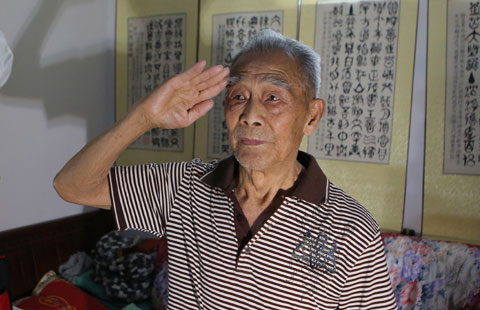
CHANGCHUN - Forcing women into sex slavery and setting up "comfort stations" were official actions of the invading Japanese army during World War Two in Asian countries, newly publicized wartime archives reveal.
|
 |
| Special coverage: Details of the Japanese files? |
|
 |
| Japanese atrocities documented in new book? |
|
 |
| Cruel life of miners under Japanese subjugation? |
The use of "comfort women" was the state action of Japan during the war, said Su Zhiliang, a professor on the history of "comfort women" at Shanghai Normal University.
The actions harmed China, the Republic of Korea and Democratic People's Republic of Korea.
The archives showed that the first "comfort station" was in the Southeast Asian country of Indonesia on Java Island.
The invading Japanese army in northeast China, documented what happened during the war, revealing their criminality.
The files are from archives of the military police corps of Japan's Kwantung Army and the national bank of the puppet Manchurian regime, which are stored in Jilin Provincial Archives in northeast China.
The 25 files on "comfort women" include two investigation reports, two telephone records and 21 documents on troops forcing women to have sex and enslaving them.
They revealed conditions at "comfort stations", including ratios between Japanese soldiers and "comfort women" and details of gruesome rapes.
The invading Japanese army allocated women proportionally.
In Feb. 1 to 10 in 1938, there were six "comfort women" for 1,200 soldiers, a ratio of 1:200, in Xiaguan district of east China's Nanjing. After Feb. 20, there were eleven more "comfort women", representing a ratio of 1:71.
In five months since November 1944, the invading Japanese army paid 532,000 Japanese yen on setting up "comfort stations". The expenditure was approved by the Kwantung Army, said a telephone record of the national bank of the puppet Manchurian regime.
The invading Japanese army had abducted and forced women from occupied Korea to some "comfort stations" in Chinese regions, such as Heihe in northeast China's Heilongjiang Province and Wuhu in eastern China's Anhui Province, according to the files.
Invading Japanese troops set up "comfort stations" everywhere they reached. The stations appeared in at least twenty to thirty counties in northeast China, said Su Zhiliang.
"The archives showed that the 'comfort station' in Java in Indonesia, strongly demonstrated the 'comfort women' system had reached the southeast Asian country," he said.
One soldier of the police corps was reported and received a verbal criticism after he went to a "comfort station" on March 5, 1944, recorded on a monthly report of the invading Japanese troops in Java.
Several letters Japanese soldiers wrote but seized by army officers expose the invaders' rapes of local women. "Japanese armies raped tens of thousands of women in Nanjing, including a 12-year-old girl, and many were even killed thereafter. The crimes were appalling," said one letter.
The documents represent only a small portion of the nearly 100,000 wartime Japanese files in 1931-1945 period retrieved underground during construction work in 1953, said Yin Huai, president of the Jilin Provincial Archives in Changchun, capital of Jilin Province. Ninety percent of the files are in Japanese.
"The files recorded by the invading Japanese troops themselves are the real documents about their invasion history in China. They are of significant value," said Yin.
The invading troops buried some of their archives when fleeing Changchun, the then "capital" of the puppet Manchu State, in wake of a war with the Soviet Union, as they had no time to burn the documents.
The Jilin Provincial Archives started in 2013 to translate and study the archives. Further work is under way.


Copyright 1995 - . All rights reserved. The content (including but not limited to text, photo, multimedia information, etc) published in this site belongs to China Daily Information Co (CDIC). Without written authorization from CDIC, such content shall not be republished or used in any form. Note: Browsers with 1024*768 or higher resolution are suggested for this site.
License for publishing multimedia online 0108263 Registration Number: 130349