China to boost education for vulnerable groups
Special education tops the agenda for two recently-approved regulations that also target improving disease prevention measures and rehabilitation services for the estimated 85 million people with disabilities in China.
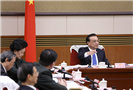
An executive meeting of the State Council, presided over by Premier Li Keqiang on Jan 11, approved a new regulation on prevention and rehabilitation for people with disabilities, as well as a draft amendment on the regulation on education, which was promulgated in 1994, according to a statement released after the meeting.
The amendment requires that educational resources for special education be properly allocated to different regions while quality should be improved with teachers' incomes raised, in addition to a prerequisite to ensure nine-year compulsory education for children with disabilities from primary to middle school.
Meanwhile, the new regulation stipulates that the government will offer more funds to target the causes of disability and strengthen rehabilitation services for those suffering from it.
The premier regards this field as crucial in promoting social equality. Compulsory education has to be ensured for these students and occupational education should be expanded while discrimination faced by these children must be eliminated, the premier said.
This is in line with the premier's and the central government's endeavors to improve people's livelihoods, especially regarding education.
In January 2014, during a teleconference on special education, the premier said it is vital to ensure equal rights for people with disabilities, boost their welfare and promote social fairness. He called on governments at all levels to fully implement plans to guarantee that all children with disabilities receive quality education like their peers.
Liu Liying, a professor of arts at the Nanjing Normal University of Special Education, said the new documents demonstrate a further step on the road to social fairness. They will further ensure equal opportunities for schooling in different regions and are beneficial to a balanced and diversified special education system, Liu said.
According to the 2015 Statistical Communique on the Development of Education in China, the country runs 2,053 special education schools, employs 50,300 teachers and provides instruction for more than 440,000 students.
The ratio of students to teachers has been rising over the past 11 years, from 3.35 in 2009 to 4.03 in 2015, according to Wang Yan, director of the Institute of Special Education at Beijing Normal University.
Proper allocation of educational resources will give more priority to special education in the central and western parts of the country against the background of a disparity with the more affluent east, said Wang.
Rural areas will get more support to develop special education while poverty-stricken and border areas will benefit to achieve a balance between these regions, Wang said.
Compared with their peers, special education teachers face more challenges and a lack of social recognition and low payment have been the main reasons that some have quit, Wang said.
Wang's viewpoint was echoed by Ma Zhuqing, 30, who has been teaching autistic children for five years at a special education school in Nanchang, capital of Jiangxi province.
Children with autism often concentrate on their own worlds and teachers require patience and foresight to establish the trust essential for success, she said.
"We have to find something to interest a child. Only in this way can we build the intimacy and trust required," Ma said.
Ma and her colleagues must adjust their techniques to adapt to the needs of each child. Several colleagues left because they found the task too challenging, especially with a low salary, she said, but the trouble is it takes at least five years to train them.
The key to improving special education lies in more supportive policies and funds, as well as efforts to attract and keep young teachers in their posts, Wang added.