|
|

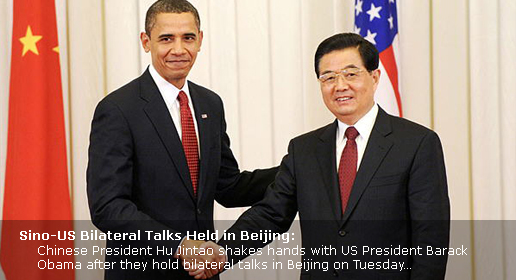
US President Barack Obama Visits China 2009
> Hot Topics
|
China awaits US climate pledgeBy Nancy Fowler Larson (China Daily)
Updated: 2009-11-17 07:27 United States President Barack Obama will likely head to meetings this month with President Hu Jintao with a fuzzy bottom line about what the US will agree to at December's international climate change summit in Copenhagen. As the two leaders prepare to talk today, the chances of the US passing climate change legislation -- the key to the US' negotiating position at the summit - seem slim. While the US Congress debates a pair of bills, China and the rest of the world are waiting to find out what to, if any, greenhouse gas emissions caps the US will commit. Experts say if Washington does not pass either bill before the Dec 7-18 Copenhagen conference, the US will not agree to any firm numbers. In 1997, the US went to the Kyoto summit without any pre-approved figures from Congress, and Obama doesn't want to be in the same situation this time around. On Nov 5, House Democrats passed through committee the Kerry-Boxer climate change bill that would mandate cuts in greenhouse gas emissions by 20 percent from 2005 levels over the next decade. The American Clean Energy and Security Act, approved by the House in June, would reduce emissions 17 percent by 2020. By 2050, both would cut emissions by 72 percent.
"The fact that Congress is really focused on healthcare and most of our committees are really focused on healthcare, it's hard to imagine being able to move something as big as climate change in that time frame," said Taiya Smith, a senior associate in the Carnegie Institute's Energy and Climate Programs. In recent published reports, Obama's climate envoy Todd Stern quashed the idea that the meeting between Hu and Obama will produce a substantial early accord. Julian Wong, a senior policy analyst at the Center for American Progress, agreed. "There may be some cooperation but not some sort of back-door, side deal on climate and carbon emissions targets," Wong said. This past summer and again in early fall after Hu and Obama talked by phone, there were numerous reports that the two countries would come to some kind of bilateral agreement during their November talks. But experts say the two are only beginning to understand each other's issues. "I really hope that when President Obama and President Hu meet, they're able to deepen that understanding and have some sense of where these two countries want to get. But that's different than signing, bilaterally, something that's subject to a multilateral agreement," said Deborah Seligsohn, the China program director for the World Resources Institute's Climate, Energy and Pollution Program. The US wants to start fresh without a Kyoto-based agreement. Developing countries want a Kyoto-II-type deal and the Europeans are hoping for something in between, Smith said. The best possible, most likely scenario for Copenhagen, whether or not the US has legislation to take with it, would be a framework, not a fleshed-out agreement, that would address the following issues: Caps on emissions for developed nations like the US; Eventual caps on emissions by large, developing countries like China; and Monetary compensation for smaller, undeveloped countries for lost shoreline and other land, and population relocation. "I think Copenhagen will not necessarily be the be-all and end-all. What will make Copenhagen a success is if the members of the convention agree to the architecture of an agreement," Wong said. A bare-bones pact would buy the US and others more time. Numbers could be filled in until 2012, when Kyoto Protocol expires. Any cap-and-trade agreements would also likely be postponed until then. Without any climate change legislation to bring to the table, the US will have to tout the fact that it's at least working on it, but the lack of firm commitments still puts the country in a position to be blamed if talks break down. "It's looking less and less likely that there will be a final bill passed by mid-December so in terms of what the US parties need to do in Copenhagen is try to communicate the fact there is progress being made in Congress," Smith said. "But not having legislation puts the specter of the US being blamed for Copenhagen not producing a global deal quite high." In the meantime the US is trying to "manage expectations" to try and prevent a blame game, according to Smith, even as other stakeholders such as those in European countries pin their hopes on Obama. "Awarding Obama the Nobel Peace Prize appears to be a not-so-subtle hint that they want to see Obama take action. But that type of a hint misunderstands how the US system works," Smith said. "It really is beyond the control of the administration at this point to ensure Congress comes up with legislation."
|
       |
主站蜘蛛池模板: 平舆县| 新津县| 哈密市| 仁化县| 乌海市| 大宁县| 永平县| 称多县| 莆田市| 内黄县| 陈巴尔虎旗| 随州市| 张家川| 桦南县| 大关县| 水城县| 长治县| 那曲县| 左云县| 彩票| 揭东县| 辉南县| 固安县| 梨树县| 溧阳市| 吴忠市| 肇庆市| 辽宁省| 枣庄市| 洮南市| 鹤山市| 贵德县| 邮箱| 中西区| 焉耆| 无极县| 大荔县| 遵义县| 靖边县| 开阳县| 澄迈县| 昭觉县| 邵阳市| 高淳县| 藁城市| 准格尔旗| 囊谦县| 浦城县| 呼图壁县| 顺昌县| 西青区| 绵竹市| 旬邑县| 故城县| 通榆县| 孟津县| 朝阳县| 绥中县| 襄城县| 抚顺县| 葫芦岛市| 汽车| 广灵县| 乐陵市| 牡丹江市| 台州市| 镶黄旗| 湾仔区| 石棉县| 鹿邑县| 嵩明县| 莱州市| 高碑店市| 清镇市| 松滋市| 龙山县| 抚顺市| 沙田区| 南雄市| 鲜城| 沭阳县| 浠水县|