-
News >China

Food security threat grows as farmers plow lonely furrow
2011-03-09 07:34Rising costs make living off the land less desirable, Hu Yongqi and Zhao Ruixue report in Shandong.
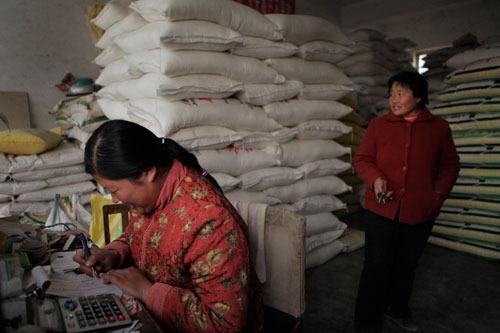
Zhang Lianjie checks her accounts at her store in Jiyang county, Shandong province. She sold 700 tons of fertilizer annually for 15 years and said her business is getting tough. [Photo/China Daily]
Li Laihao likes farming. His family has worked the land in Dongjinkou village in southern Shandong province for generations. But it gets harder each year.
Many of the neighbors who once helped with plowing and harvesting have left for the cities. Rising costs eat his profits. Li, 54, knows that someday he might need to join his children as a migrant worker.
That's more than a threat to his family's tradition. It also affects the nation's food security as millions of Chinese farmers share his plight.
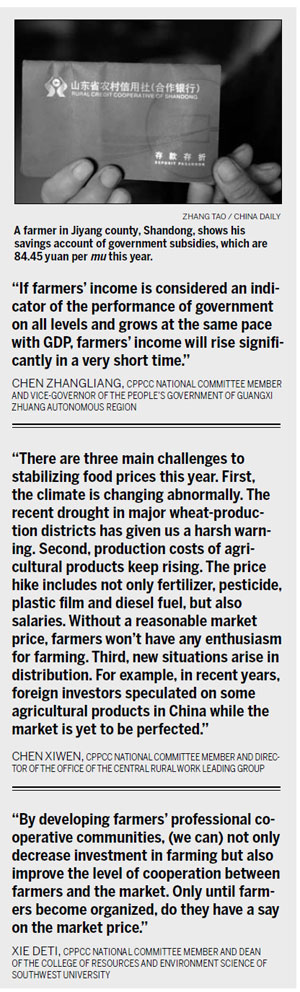
"Ensuring an adequate food supply for 1.3 billion Chinese people is always a top priority," Premier Wen Jiabao said on Saturday in delivering his annual government work report to the National People's Congress. "We must never take this issue lightly."Tens of millions of farmers are set to become city folk by 2015, as the government aims to push urbanization rate from 47.5 percent to 51.5 percent. To encourage those still plowing the fields, Wen said, the country is increasing minimum purchase prices for some grains. The price for wheat already has been raised 6 percent, to 95.40 yuan per 50 kg.
The central government exempted farmers from all agricultural taxes in 2006 and has since invested nearly 3 trillion yuan ($456.8 billion) in agriculture, rural areas and farmers. But Li still deals with the cost increases that have squeezed his profit margins and made farming a less desirable occupation, even at a time when food prices skyrocketed.
The price of mung beans and garlic, for example, more than doubled from spring to summer last year, although experts said the principal reasons were hoarding and profiteering. Farmers didn't benefit significantly.
In the end, crops are still very cheap, said Zheng Fengtian, deputy dean of the School of Agricultural Economics and Rural Development at Renmin University.
The price of wheat and corn, China's two major grain crops, increased 40 percent in the past decade, Zheng said, but agricultural materials such as fertilizers and pesticides are now five times more expensive than 10 years ago.
"Although the wholesale price of wheat rose in the last several years, the increase was too slow compared with the cost. That's why farmers earn much less than even a construction worker in the city, " he said. In 2010, rural income per capita was just under 31 percent of that for urban workers.
Tracking costs
It's the rising costs of farming that most concern Li. He opened his account books for China Daily to illustrate what he and his wife spend to work his seven mu (0.47 hectare) in Liangshan county.
On average, he said, each mu produces about 425 kg of corn and 475 kg of wheat yearly. The crops sold for 2.1 yuan per kg in 2010 for a total gross income of 12,600 yuan ($1,918). That was about 1,500 yuan more than in 2006. But agricultural materials cost 1,140 yuan more than they did in 2006.
For example, wheat seeds cost 1 yuan per jin (0.5 kg) in 2010 but less than 0.6 yuan in 2006. Corn seeds went from 3 yuan per jin in 2006 to at least 5 yuan last year. In both cases, the increase was 66.7 percent.
To fertilize his wheat and corn, Li uses at least 550 kg of urea each year. A bag weighing 100 jin sold for 92 yuan in 2006 and 104 yuan at the beginning of this year, a 13 percent increase.
So Li's neighbors are becoming more reluctant to grow crops. Dongjinkou is home to 1,400 residents, but at least 1,000 of them work in cities most of the year. The adults who are left are in their 40s and 50s, generally above hiring age in the cities, or older. Few of them are able to handle the hard work of farming.
What does that mean? Five years ago, lots of residents visited flour mills to grind their wheat in the afternoon. During festivals, Li said, he had to wait in line. Now only one mill is operating.
In years past, Li said, neighbors helped each other during busy seasons. The only cost to the farmer was for meat and vegetables to feed their volunteer workers. Now farmers hire local people or rent machines to plow, water, harvest and clear the land. The cost is 66.7 percent higher than it was five years ago, when fewer locals rushed to the cities.
The cost of irrigation is a special concern. Local farmers complain that few irrigation facilities run well, and more than 75 percent of the land has to be irrigated with water from wells they dug. Even when there are no dry spells, like the severe drought that's affecting much of northeastern China, farmers worry about the rising price of fuel to pump the water. Diesel fuel costs 4.05 yuan per jin, up more than 20 percent from 2006.
The rising price of agricultural materials is in line with national inflation, said Li Shuwen, deputy director of the Agriculture Bureau of Jiyang county in Shandong. Agricultural dealers there agree, but say their profits are not as high as might be expected.
Zhang Lianjie, 43, has sold 700 tons of fertilizer annually for 15 years. The wholesale price of urea, which adds nitrogen to the soil, is 103 yuan per bag of 100 jin, she said, but farmers pay her only 104 yuan for a bag. "I just make 0.7-yuan net profit from one bag of urea."
China's fertilizer and pesticide industry endured a dramatic increase in labor and transportation costs in the past five years, according to Xu Baocai, senior editor of Agricultural Materials and Market Magazine based in Zhengzhou, capital of Henan province.
Xu said the price of urea peaked at 2,600 yuan per ton in 2008 because of an unrealistic expectation of demand when China's economy was surging before the 2008 Olympic Games. Last year it had dropped to 2,060 yuan per ton, but the price is still 45 percent more than in 2005.
Zhang and more than 10 other dealers said that crops and fertilizer have been selling for about the same amount, effectively eliminating the impact of any price increase for fertilizer.