Youths' Reference, a Beijing-based newspaper, reprinted an article from the Wall Street Journal (WSJ) which criticizes Chinese people for their loathing of the Western media's negative reports about their country.
The author of the article is a reporter of the US newspaper and obviously a Chinese by origin.
In the article, the writer cited a number of examples to illustrate what she says is the excessive importance Chinese people attach to "face". One example was the media coverage of contaminated drugs sold at the Hualian supermarket in Shanghai. After reading the report by the Guangzhou-based South Weekend online, most readers berated Hualian and China's drug safety administration. The report of the same incident by the Wall Street Journal, however, earned for itself condemnation from angry Chinese netizens.
The author asked: "I feel puzzled why these netizens would rather bury their heads in the sand like an ostrich than know the facts, for the (foreign media's) reports at least can tell them (what is wrong with the medicines). And why should they regard the face (of China) as more important than their compatriots' livelihood and lives?"
I feel puzzled at her remarks.
Since she had noticed that the Chinese netizens had expressed their anger over the incident after learning about it from the Chinese media, how could she claim that they had turned a blind eye to it?
As for her query why Chinese people tolerate their own media's negative reports about China's affairs but are unhappy about the foreign media's coverage of China's dark side, the answer is simple.
Chinese people do not detest the domestic media's critical reports of social problems because they know the reports do not serve to cover the brighter side of society as it is so obvious to every Chinese at home. Even if the media reports are all about negative things, people are fully aware that their country's achievements and progress far outweigh the problems.
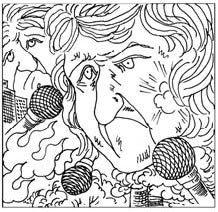
The majority of the Western media's reports about China, however, are negative. Admittedly, most of these problems do exist. The question is, do they represent China's real image? As the Western media dominates the world's journalistic arena and thus constitutes the only channel through which the world learns about China, the image of China is all problematic. Is that not a distortion? Do people of any nation like their image to be distorted the same way?
In the Hualian case, what the Chinese people resented, according to the author, was the WSJ's report. Therefore, according to her logic, these Chinese proved to be cold-blooded over a matter concerning their compatriots' lives, because they did not like the WSJ's report. What ridiculous logic.
She seemed to be very proud of being part of the WSJ, for of all the examples she mentioned, three were related to her media's outlet and one of them was an ardent defense of "our newspaper's strict standards". I would like to give her a piece of advice: to work for a prestigious newspaper like the WSJ, one needs to know at least the basic principles of journalism. For instance, when covering a topic, the reporter or commentary writer should try not to cite examples that are too closely related to his/her company.
And the writer needs to improve her language skills. At least she should learn to use the right words. For example, in her article (apparently written in Chinese for it appeared on the WSJ's Chinese website), she used "our compatriots" to refer to Chinese people. That is a mistake. Chinese people are not her compatriots. Americans are.
E-mail: liushinan@chinadaily.com.cn
(China Daily 03/19/2008 page9)


