
 Comments()
  Print
Print  Mail
Mail  Large Medium Small
 |
|
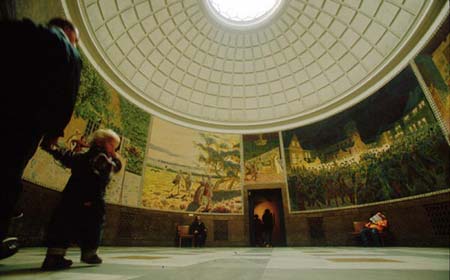
The memorial hall for Hans Christian Andersen in Odense, built in 1908 at the behest of his grandchildren, is a grand homage to a "half god / hero". After World War II, the writer would be celebrated more humbly. Provided to China Daily |
 |
|
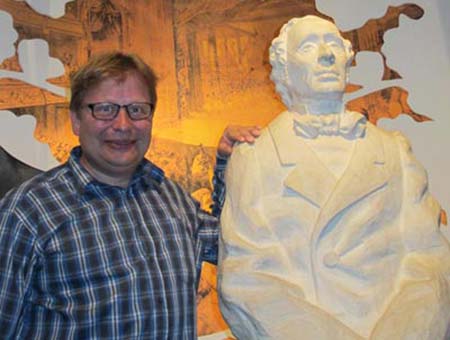
Museum curator Ejnar Askgaard says there is still much to learn about the 19th-century writer, who left behind about 20,000 letters and wrote a journal nearly every day. Mike Peters / China Daily |

'The great thing about the Hans Christian Andersen stories is that you can read them as a child, then read them again many years later and get an entirely new appreciation," says the Odense Museum's publicist Mette Ganz. Because the stories resonate with both children and adults, she adds, they work as strong themes for kindergarten parties and corporate events alike.
But it isn't just the stories that look different over time: The man who wrote them has morphed astonishingly in the public eye since his 19th-century heyday.
You can see the mythmaking at work in a quick tour of the museum.
"From the beginning, Andersen was a political creation," says Ejnar Askgaard, curator and resident historian at the museum. "The story line was: He rose from poverty to be an establishment man with an exquisite circle of friends."
Built in 1908, the museum celebrates Andersen as a model of social mobility and meritocracy.
A grandiose memorial hall reflects "the top-hatted Andersen you see in logos and commemorative books", Askgaard says. "Half god, half hero." There are murals with scenes intended to depict Andersen's life, including one where a huge crowd has gathered to hear him speak from the window of his home on a cobblestone street just a block from the museum site. "That was actually painted from a photograph of a rally for Mussolini," he adds with a wry smile.
After World War II, there was a reaction in Europe against hero worship - "this was feared", Askgaard says. So Andersen is now seen as a gentle, old, friendly guy: quiet, harmless, a humanistic role model. "Visiting dignitaries (Nikita Kruschev, Josephine Baker, Indira Gandhi and Yuri Gagarin) have come to the museum to be photographed in that context," he says.
In real life he was more complicated, fascinating to no one more than Andersen himself, who wrote three different autobiographies - the first when he was about 30. If that seems presumptuous today, Askgaard says, "remember that people didn't live as long then, and often had achieved whatever success life would give them by 30." Mozart, he notes, was dead at 33.
Andersen was obsessed with death and his own mortality, a theme that underpins much of his writing. A successful writer abroad, he was enormously popular in Germany but didn't get the same recognition at home. Andersen found family matters difficult and married neither of the two women to whom he proposed. He is said to have died with a decades-old letter from one of the women he hopelessly loved in his coat's breast pocket.
Now totally in the public domain, especially in Denmark, the writer has been adopted as a symbol by groups from the gay to the gluten-allergic. "He's a black hole, you can put anything in," Askgaard says.
Getting a true read on the legendary storyteller was tough for Danish sculptor Bjoern Noergaard, who was commissioned to make the statue of Andersen that stands in Odense's main public square.
Noergaard, who regularly travels to China to teach master classes in art, pushed past the well-known noble and folksy images to create three intertwined figures that show a man tortured by human emotions.
"Not everyone was happy with this image," says the Odense Museum's Ganz. "But when the statue was dedicated, people lined up for hours to get a piece of the casting mold."
Entranced by fantasy and theater "where everything was made beautiful", Andersen left home at the age of 14, seeking the stage lights of Copenhagen. But his rural roots are mirrored in his work. While Germany's famous storytellers, the Grimm brothers, had to travel to the countryside to record the superstitions of life there, Andersen was rooted in that culture from birth.
"In that time and place," Askgaard says. "It was not so strange to talk to flowers or to believe you could communicate with animals." Today in the West, he says, "the surface of my skin is the border of my 'I', but back then your surroundings were part of you".
The great Danish astronomer Tycho Brahe said, "The firmament is the mirror of our souls." In such a context, the Andersen historian says, "Your 'I' has to be quite big."
michaelpeters@chinadaily.com.cn



Copyright 1995 - 2010 . All rights reserved. The content (including but not limited to text, photo, multimedia information, etc) published in this site belongs to China Daily Information Co (CDIC). Without written authorization from CDIC, such content shall not be republished or used in any form. Note: Browsers with 1024*768 or higher resolution are suggested for this site.
License for publishing multimedia online 0108263 Registration Number: 20100000002731