Comments()
  Print
Print  Mail
Mail  Large Medium Small
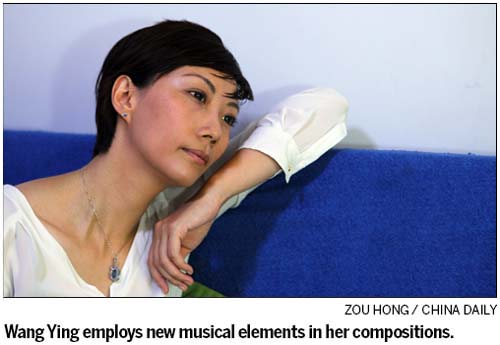
Wang Ying is the first female composer to win an international music composition award. She shares her musical journey with Chen Nan.
Wang Ying has emerged as the first female composer to win the Fifth Biennial Brandenburg Symphony Composition Competition, with three works.
Her Phantasmagoria from 2008; Steel, Steam, Storm in 2009; and Focus-Fission in 2011; stood out among 245 compositions from 34 countries.
She says the works mark the different stages of her composing career. "They reflect a clear line of how I grew and evolved musically."
She did not expect to win the award, but is happy that, finally, a woman composer is given recognition.
At 36, Wang looks almost fragile - slim, wide-eyed and neat. Her three award-winning pieces are a huge contrast to her feminine appearance - they are powerful, dramatic and spirited. The masterpieces broke conventional ideas about a female composer, normally perceived to produce works which are tender and delicate.
Wang employs a large amount of creativity and new musical elements in her composition.
"During hours and hours of composition, I like challenging myself and breaking conventions with new ideas," she says.
Performed by Helsinki Philharmonic Orchestra in June 2008 for the first time, Phantasmagoria depicts a grand and colorful scene. Wang focused on the tension and density in her work.
Steel, Steam, Storm was performed to a full house in Cologne, German, on June 18 and 19, 2009, boosting Wang's confidence.
Focus-Fusion was performed by Guerzenich Orchester and conducted by Markus Stenz on Jan 20, 2012, which reflects Wang's maturity in terms of composition.
Coming from an artistic family - her father is a renowned Chinese composer and her mother was a dancer - Wang started piano lessons at 4. But she was exposed to music at an even younger age. She recalls her father playing world-renowned pieces when she was about 2 years old and deliberately repeating parts, just to watch her reaction and test her memory of the melody.
His efforts laid a firm musical foundation for Wang.
Did Wang's mother want her to be a dancer?
"The competition between my father and mother was always there. Both of them wanted me to follow in their footsteps. But finally my father won because dancing is a short-lived career," she says.
Wang graduated with first class honors from Shanghai Conservatory of Music in 2003, and proceeded to study composition at the Cologne Academy of Music in Germany.
When she first arrived in Germany, she felt lost. "I listened to lots of music, which I had never listened before. I went to concerts by different symphony orchestras and visited many exhibitions. It was cultural shock. I felt overwhelmed. But I also realized that I had lost my own style," she says.
She spent more than two years figuring a way to find her musical language. Wang studied for one year under Rebecca Saunders, 45, a female composer from London - the experience greatly inspired Wang and helped her find her style.
But during the process, she did not try integrating traditional Chinese music elements, which was a popular thing to do among many overseas Chinese musicians. Some Chinese musicians feel that by incorporating traditional Chinese music elements in their compositions, they remind audiences of their nationality. But Wang holds a different view.
"I didn't grow up in a conservative environment full of traditional Chinese folk music. Like many young people in China then, I listened to rock heroes like Cui Jian, He Yong and Dou Wei. I prefer discovering, exploring and interpreting traditional Chinese music my own way," Wang says. "As a composer, I am individualistic, rather than typical."
After obtaining a master's degree, Wang ascended to the highest German composer degree - Masterclass. In 2010, she obtained the Composer Masters diploma, issued by the Cologne Academy of Music, and an electronic music degree.
In 2011, she studied at IRCAM, an acclaimed music laboratory in Paris, which opened a new world of composition. She studied the most avant-garde music theories and approaches, which breathe new life into her works.
"Composers are loners, nobody understands your ideas except yourself," she says. "The most exciting and satisfying moment is listening to your works being played and shared by listeners."
As an overseas Chinese musician, Wang has frequently cooperated with Chinese artists and organizations. She was invited to compose for the 2011 new year's eve concert by the Chinese father of rock 'n' roll, Cui Jian.
"But maybe the music I composed for him was too pioneering so he didn't use it," Wang laughs. "But the cooperation allowed me to do more experiments on composition."
Wang's idol is her father, who has been constantly encouraging her. In 2011, she listened to her father's work, Symphony No 7, on a subway in France. She says although the surroundings were noisy, the effect of her father's work remained astonishing to her ears.
"My father often shares his views on composition with me. He is serious and persistent about his music style. He also tells me that even though I am a woman, I should be strong and independent," Wang says. "Being a female composer has an advantage - sensitivity. Women are like bamboo, we bend with the wind, but we can never be broken."
Contact the writer at chennan@chinadaily.com.cn.



Copyright 1995 - 2010 . All rights reserved. The content (including but not limited to text, photo, multimedia information, etc) published in this site belongs to China Daily Information Co (CDIC). Without written authorization from CDIC, such content shall not be republished or used in any form. Note: Browsers with 1024*768 or higher resolution are suggested for this site.
License for publishing multimedia online 0108263 Registration Number: 20100000002731