 |
|
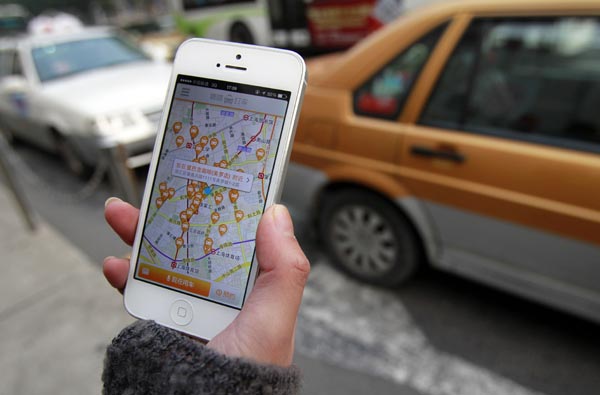
A customer checks his smartphone app that eases finding a taxi. Ding Ding / China Daily |
The debate over taxi services, cabbies' incomes and passenger complaints is not over. Thousands of cabbies in major cities such as Shanghai have gone on strikes against Uber-like apps, including the Didi Taxi and Kuaidi Taxi, despite the Ministry of Transport banning the use of private cars as taxis earlier this month.
But the fact is, companies providing Internet-based car services are yet to enter the taxi or car rental business in China. Current regulations allow taxi companies to operate vehicles that can seat seven or fewer passengers. On the basis of mileage and duration, taxi companies can offer "cruising" and "appointment-oriented" services. The former means picking up passengers at random and the latter means providing taxis on appointments, for which luxury vehicles could be used.
The management of car rental business in China varies from region to region, which means they are largely dependent on local rules.
Despite the revolutionary changes that the Internet has brought about to all industries, companies like Didi Taxi only serve as an information platform processing traffic-related data; they provide neither taxi drivers nor taxis of their own. And they are not breaking any law by helping passengers hire taxis, because China has no relevant laws covering this aspect of transport business.
There is a misunderstanding about the taxi business in the country, especially in relation to "monopoly". In effect, the assertion that the "monopoly" of State-owned taxi companies is to blame for the current crisis is an exaggeration because at least in mega cities like Beijing there is no monopolized taxi business.
According to China's Antimonopoly Law, proprietors shall be deemed monopolistic once they reach a monopoly agreement with each other, abuse their domination in the market, or conduct concentration of undertakings that could in effect eliminate or restrict competition. Beijing, for example, has more than 250 taxi companies, about 1,157 individual taxi owners, and nearly 100,000 drivers. So where is the monopoly?



I’ve lived in China for quite a considerable time including my graduate school years, travelled and worked in a few cities and still choose my destination taking into consideration the density of smog or PM2.5 particulate matter in the region.
Copyright 1995 - . All rights reserved. The content (including but not limited to text, photo, multimedia information, etc) published in this site belongs to China Daily Information Co (CDIC). Without written authorization from CDIC, such content shall not be republished or used in any form. Note: Browsers with 1024*768 or higher resolution are suggested for this site.
License for publishing multimedia online 0108263 Registration Number: 130349