 |
|
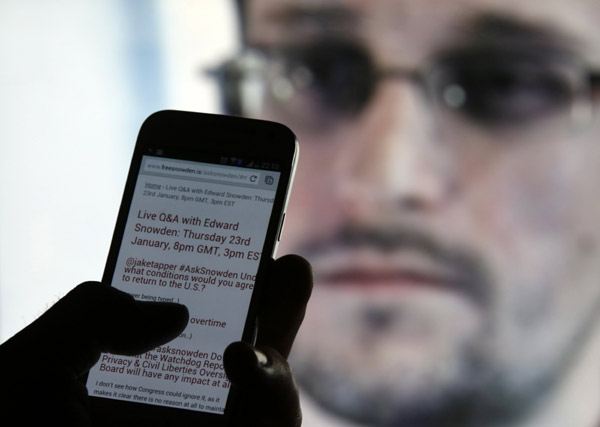
A man uses his cell phone to read updates about former US spy agency contractor Edward Snowden answering users' questions on Twitter in this photo illustration, in Sarajevo, Jan 23, 2014. [Photo/Agencies] |
It's time the pot stopped calling the kettle black, that is, the United States stopped accusing China of cyber-espionage. New revelations from former National Security Agency operative Edward Snowden's leaked documents show hackers from New Zealand and the US hatched plot to spy on China by hacking into a data link between Chinese consulate buildings in Auckland.
If true, the espionage plan adds to the US' massive global surveillance, which Snowden exposed in 2013, and shows that Washington has continued not only to spy on Beijing and Moscow, but also on its close European allies.
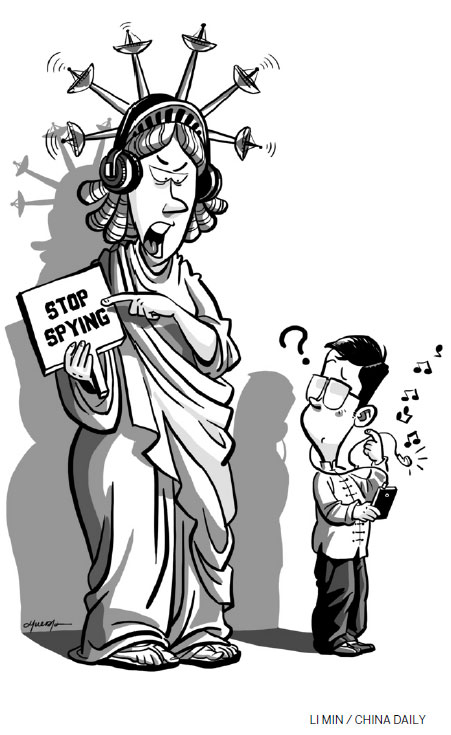
Yet the US has never let an occasion go without accusing China of cyber-spying. Last week, cyber security company FireEye said the Chinese government "supports" a hacker group "APT30" to spy on neighboring countries for a decade. Apparently, FireEye's aim is to drive a wedge between China and its neighbors at a time when Beijing is rallying support for vital economic moves like the "Belt and Road Initiatives" and the Asian Infrastructure Investment Bank, as well as make noises ahead of the Asian-African Summit this week.
These clumsy tricks, however, have only succeeded in exposing the true face of the US, which sees itself as "global cyber cop".
In the past, the Western media always quoted Google to tell similar stories. In fact, Google and FireEye have a common shareholder, namely In-Q-Tel, which, as is clearly stated on its official website, supports "the missions of the Central Intelligence Agency and broader US Intelligence Community". Besides, FireEye has business relations with about 40 military enterprises across the world, and early last year it purchased Mandiant, which specializes in fabricating reports on China as a cyber-threat.
The Western media have been speculating about China's role in cyberattacks since 2007. While US officials have accused "Chinese hackers" of attacking the Pentagon network, Google has alleged that it came under Chinese cyberattack in 2010. The New York Times even traced the source of the cyberattacks to Lanxiang Senior Technical School in Shandong province, sparking a wave of jokes on Chinese online forums.
Even the APT30 story sounds hollow. Last year an alliance of FireEye, Novetta, Sisco and Microsoft worked out a way to disrupt Chinese "cyber gang Axiom's antics", but instead of providing evidence to prove the existence of such a "gang", they said the IP addresses are based in China. What they didn't say (or didn't want to say) is that hundreds of such IP addresses are also based all around the world.
The last but no less effective method is to list the wrongdoings of other countries and change their sources to China. For example, when the Prism scandal revealed that the US had a cyber-warfare weapon called Quantum, the storytellers fabricated one for China, too, and even gave it a catchy name: "Super Cannon".
It is because of its own strategic interests that the US has helped spread speculations about China. After the Prism scandal, China and many other countries started taking measures to promote cyber security. But their sincere efforts drew protests from the US government and some enterprises. As a ploy to ease the pressure on itself and shift attention elsewhere, the US is adept at sensationalizing China as a cyber-threat.
Moreover, despite giving up the control of ICANN (the Internet Corporation for Assigned Names and Numbers), the US can still try to get a favorable reform plan. Plus, the new cybersecurity strategy to be issued by its Department of Defense will make the US more secure against cyberattacks. This shows the US uses numerous pretexts and tricks trying to maintain its hegemony in cyberspace.
The author is a senior researcher at and director of cybersecurity institute, a CCID think tank affiliated to the Ministry of Industry and Information Technology.



I’ve lived in China for quite a considerable time including my graduate school years, travelled and worked in a few cities and still choose my destination taking into consideration the density of smog or PM2.5 particulate matter in the region.
Copyright 1995 - . All rights reserved. The content (including but not limited to text, photo, multimedia information, etc) published in this site belongs to China Daily Information Co (CDIC). Without written authorization from CDIC, such content shall not be republished or used in any form. Note: Browsers with 1024*768 or higher resolution are suggested for this site.
License for publishing multimedia online 0108263 Registration Number: 130349