 |
|
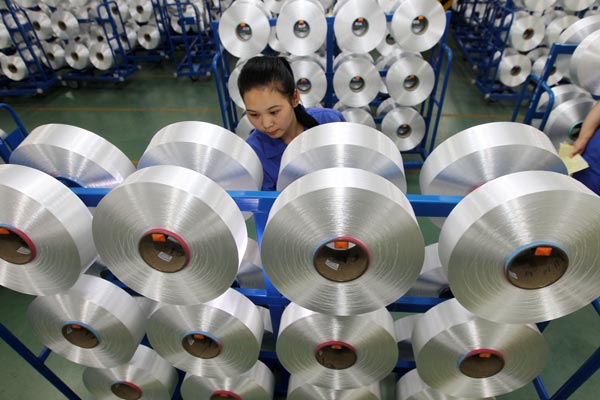
A worker inspects rolls of polyester fiber at a factory in Nantong, Jiangsu province. [Photo/China Daily] |
The economies of the United States and China - indeed, the entire global economy - are suffering from weak aggregate demand, which is creating deflationary pressures. As central banks attempt to combat these pressures by lowering interest rates, they are inadvertently causing re-leveraging (an unsustainable growth pattern), elevated asset prices (with some risk of a downward correction given the slow growth), and devaluations (which merely move demand around the global economy, without increasing it).
For China, which to some extent still depends on external markets to drive economic growth, this environment is particularly challenging - especially as currency depreciation in Europe and Japan erode export demand further. Even without the crisis in major external markets, a large and complex middle-income economy like China's could not realistically expect growth rates above 6-7 percent.
Investment can sustainably drive growth only up to the point when returns decline dramatically. In the case of public-sector investment, that means the present value of the increment to the future GDP path (using a social discount rate) is greater than the investment itself.
The good news is that growing discipline seems to be pushing out low-return investment. And there is every reason to believe that investment will remain high as the economy's capital base expands.
But in order to boost demand, China will also need increased household consumption and improved delivery of higher-value services. Recent data suggest that, notwithstanding recent wage increases, consumption amounts to only about 35 percent of GDP.
With a high household savings rate of about 30 percent of disposable income, per capita disposable income amounts to roughly half of per capita GDP. Expanded social-security programs and a richer menu of savings and investment options could go a long way toward reducing precautionary savings and boosting consumption. But what is really needed is a shift in the distribution of income toward households.
Without a concerted effort to increase households' share of total income and raise consumption's share of aggregate demand, growth of consumer products and services on the supply side will remain inadequate. Given that services are a significant source of incremental employment, their expansion, in particular, would help to sustain inclusive growth.
Another key challenge is China's slumping property sector, in which construction and prices dropped rapidly last year. If highly leveraged developers are under stress, they could produce non-performing loans - and thus considerable risk - in both the traditional and shadow banking sectors.
Fortunately, Chinese households' relatively low leverage means that the kind of balance-sheet damage that occurred in some advanced countries during the crisis, leading to a huge drop in demand, is unlikely, even if real estate prices continue to decline. It also means that there remains some space for expanding consumer credit to boost demand.
That is not the only source of hope. Wages are rising, deposit insurance will be introduced, and deposit rates are being liberalized. Internet investment vehicles are growing. New businesses in the services sector - 3.6 million of which were started just last year - are generating incremental employment, thanks partly to a new streamlined licensing framework. And online platforms are facilitating increased consumption, while expanding market access and financing for smaller businesses.
China's leaders should take measures to accelerate and build upon these trends, rather than pursuing additional fiscal and monetary stimulus. Public investment is high enough; expanding it now would shift the composition of aggregate demand in the wrong direction. And, with the corporate sector already over-leveraged, a broad-based expansion of credit is not safe.
Any fiscal stimulus now should focus on improving public services, encouraging consumption and increasing household income. Accelerating the expansion of State-funded social security could bring down household savings over time. More generally, China must deploy its large balance sheet to deliver income or benefits that expand what households view as safely consumable income. Given that private investment responds mainly to demand, such measures would likely reverse its current downward path.
The author, a winner of the Nobel Prize for Economics, is a professor of Economics at New York University's Stern School of Business and senior fellow at the Hoover Institution.
Project Syndicate



I’ve lived in China for quite a considerable time including my graduate school years, travelled and worked in a few cities and still choose my destination taking into consideration the density of smog or PM2.5 particulate matter in the region.
Copyright 1995 - . All rights reserved. The content (including but not limited to text, photo, multimedia information, etc) published in this site belongs to China Daily Information Co (CDIC). Without written authorization from CDIC, such content shall not be republished or used in any form. Note: Browsers with 1024*768 or higher resolution are suggested for this site.
License for publishing multimedia online 0108263 Registration Number: 130349