 |
|
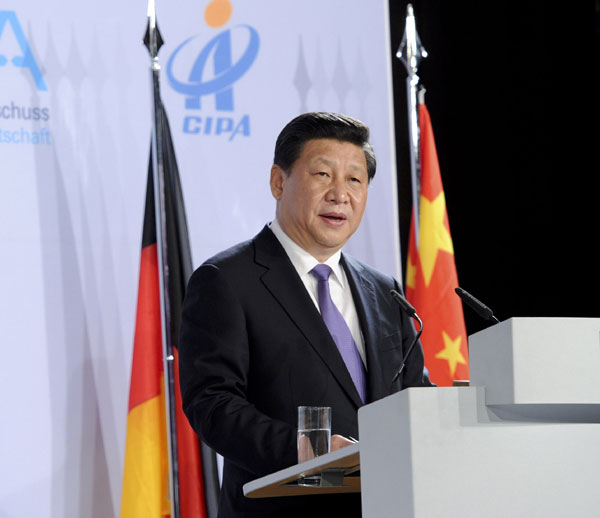
Chinese President Xi Jinping delivers a speech during a banquet with Chinese and German business representatives in Duesseldorf, Germany, March 29, 2014.[Photo/Xinhua] |
Since China proposed the Silk Road Economic Belt and 21st Century Maritime Silk Road initiatives in 2013, German think tanks have been paying special attention to the projects. And some German experts on China can influence their country's policymakers.
One such expert, Nadine Godehardt, a researcher with the German Institute for International and Security Affairs, said in a June 2014 report the "Belt and Road Initiatives" were "a reaction" to the US policy of "rebalancing in Asia" on one hand and an extension of China's 2011 New Silk Road Strategy on the other. Godehardt also saw the initiatives as an answer to Russian President Vladimir Putin's idea of Eurasian integration.
Saying that Germany and other European countries, even the West as a whole, paid little attention to China's influence in its western neighborhood, Godehardt also viewed the initiatives as "a proof that the Chinese leadership will more confidently represent the political and economic interests of the country". Godehardt belongs to the group of German experts who in general have a positive view of the "Belt and Road Initiatives".
Another German expert, Moritz Rudolf, of the Mercator Institute for China Studies, has said that, "instead of simply connecting China with Europe", the initiatives are "aimed at building a China-centric infrastructure network that covers the whole region", which would strengthen "its political and economic ambition overseas".
And last year Helga Zepp-LaRouche, founder of the Hannover-based Schiller Institute, reiterated in several interviews that while the Silk Road opened an epoch of mutual understanding for humankind, the new Silk Roads combined with modern technology would signal the beginning of a new age, in which countries can realize their common goals through more intimate connections instead of resolving conflicts through war.
For Godehardt, regional political stability is a major concern for the initiatives, especially the threat of terrorism in Afghanistan and lack of political stability in Central Asian countries. She says China should factor in the regional security problems to build a security belt out of the initiatives.
Mainstream German think tanks believe China's initiatives are in accordance with German and European interests, and thus offer opportunities for coordination. Eberhard Sandschneider, of the German Society for Foreign Policies, said "Germany is interested in a more intimate trade relationship with China ... based on reciprocity". China needs support from Germany, too, to strengthen trade ties with the West and better deal with domestic economic challenges, he said.
In his 2014 article, "Germany's China Policy Takes a Leading Role in Europe", Sebastian Heilmann, founding director of Mercator Institute for China Studies, said Beijing offers a good chance for concrete cooperation and the economic belt in Central Asia will help promote German and European policies. There are already "existing European policies that are complementary" to the initiatives, Heilmann said, referring to the Transport Corridor Europe-Caucasus-Asia, which connects Europe with Asia, and INOGATE, an energy program between Europe and countries bordering the Black and Caspian seas. These policies make it possible for China and Germany, even other European countries, to work together in Central and West Asia.
Also, in her report the "Belt and Road Initiatives", Godehardt advised the European Union to hold formal talks with China on the initiatives, saying they offered two specific benefits. First, they will simplify the exchanges of ideas over interests, projects and investments. China has already held programs such as a conference on urbanization in Urumqi, capital of Xinjiang Uygur autonomous region, in December 2013, but no European representative participated.
Second, Godehardt said, talks between China and the EU can help identify sectors in which the two sides can have purposeful cooperation. For that, they have to hold detailed dialogue instead of just meeting to set abstract targets, especially because China-EU ties are already highly institutionalized. Infrastructure, agriculture, environmental protection and urbanization are sectors where they can cooperate.
If heeded, Godehardt's advice could lead a step closer to a dialogue on the "Belt and Road Initiatives" and make official coordination between China and the EU a reality.
The author is vice-director of and associate professor in the Department of German Studies, Beijing Foreign Studies University.



I’ve lived in China for quite a considerable time including my graduate school years, travelled and worked in a few cities and still choose my destination taking into consideration the density of smog or PM2.5 particulate matter in the region.
Copyright 1995 - . All rights reserved. The content (including but not limited to text, photo, multimedia information, etc) published in this site belongs to China Daily Information Co (CDIC). Without written authorization from CDIC, such content shall not be republished or used in any form. Note: Browsers with 1024*768 or higher resolution are suggested for this site.
License for publishing multimedia online 0108263 Registration Number: 130349