 |
|
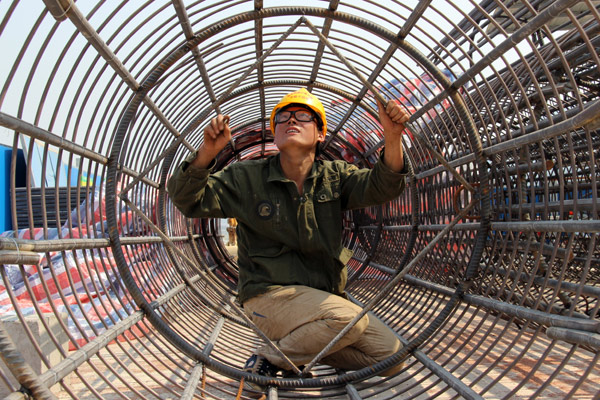
A worker checks a bridge reinforcement at a construction site of the Yiyang-Loudi Highway in Central China's Hunan province. China's GDP growth slowed to 7.4 percent in 2014, the lowest reading since 1990. [Li Aiming / China Daily] |
For a quarter of a century, China's economic crash theory has been a lucrative cottage industry in the West. But there is a reason why certain times favor the doomsayers.
At the turn of the millennium, the economic crash theory was exemplified by Gordon Chang's The Coming Collapse of China (2001). In reality, that's when China became a member of the World Trade Organization and growth soared to double digits until the West's financial crisis in 2008-09. So any investor who took the theory seriously lost big time.
After the crisis, new concerns surfaced. Since China relied on export-led growth and world trade plunged, the crash prophets predicted the collapse of its economy. The truth is, as demand in the West plunged, so did China's import growth. China adjusted to a new, but far more challenging environment.
Then came the concerns over the overheated property market. In a January 2010 interview with The New York Times, hedge fund short-seller James Chanos predicted the Chinese economy would crash, resembling "Dubai 1,000 times - or worse". But still China did not crash. Instead, the "hard-landing" prophecies were offset by realities of "slow landing", as I argued at the time.
Today, as the world economy is anxiously preparing for US interest rate hikes, the crash oracles are in fashion again, as evidenced by scholar David Shambaugh's article, "The Coming Chinese Crackup", in The Wall Street Journal in March. It was followed by The Washington Post columnist Robert Samuelson's "China's coming crash?" recently.
Some of these recurrent predictions are more cautiously worded, others are misinformed or flawed, and some are simply biased. But they all share a common denominator. They peak amid challenging economic times in the West, not always in China. For some crash theorists, China is a convenient scapegoat for economic challenges in the West.
Certainly, China has challenges of its own. But how serious are they?
Last year, China's growth rate was 7.4 percent, the slowest since the global financial crisis. In spring, the economic data signaled slowing manufacturing, disinflation and depreciation pressures fueled by capital outflows. So the People's Bank of China has cut the required reserve ratios and interest rates, while the government has revived targeted mini-stimulus policies.
In the second quarter, China's growth rate may decrease to 6.6 percent, and below 6.5 percent in the third quarter. The annual growth is expected to be slightly less than 7 percent, within the target bounds.
As the policy rate is being cut closer to 2 percent, consumer inflation, too, is expected to climb from the low of 1.4 percent in the first quarter to 2.5 percent at the end of the year.
Internally, China's deceleration reflects the eclipse of the demographic transition as the share of working-age people in the total population has been on decline since 2010. Externally, it signals slower demand in the stagnating advanced economies. However, the "Belt and Road Initiative" supports economic integration across Asia and beyond. Moreover, China-proposed Asian Infrastructure Investment Bank will strengthen demand for raw materials and commodities in the region.
But real downside risks remain. And these risks could get bigger if the government's stimulus policies fail to support growth or if easing policies prove ineffective. In turn, such risks could be compounded by further declines in property prices.
The government, however, could cope with such challenges by launching new stimulus measures, or absorbing the losses on financial institutions' balance sheets. In turn, China's central bank could intensify easing and allow the yuan to depreciate faster.
Structural reforms are likely to strengthen toward the end of the year, when some analysts expect vital changes, including deposit-rate liberalization and reform in State-owned enterprises. While property developers continue to struggle with oversupply and price correction, sales could pick up later in 2015.
According to the crash oracles, Chinese consumption, which was 37 percent of GDP in 2014, should be closer to 70 percent as in the US. In reality, Chinese consumption has increased dramatically at the expense of investment. Moreover, consumption levels differ between advanced and emerging economies. And the level of consumption is no panacea.
Ultimately, growth deceleration is only a part of the big picture. From 2010 to 2015, China's growth has decelerated from over 10 percent to less than 7 percent. And yet China's per capita income has almost doubled.
In the West, governments and central banks are running out of ammunition. That is not the case in China.
The author is research director of International Business at India China and America Institute (US) and visiting fellow at Shanghai Institutes for International Studies (China) and the EU Centre (Singapore).



I’ve lived in China for quite a considerable time including my graduate school years, travelled and worked in a few cities and still choose my destination taking into consideration the density of smog or PM2.5 particulate matter in the region.
Copyright 1995 - . All rights reserved. The content (including but not limited to text, photo, multimedia information, etc) published in this site belongs to China Daily Information Co (CDIC). Without written authorization from CDIC, such content shall not be republished or used in any form. Note: Browsers with 1024*768 or higher resolution are suggested for this site.
License for publishing multimedia online 0108263 Registration Number: 130349