 |
|
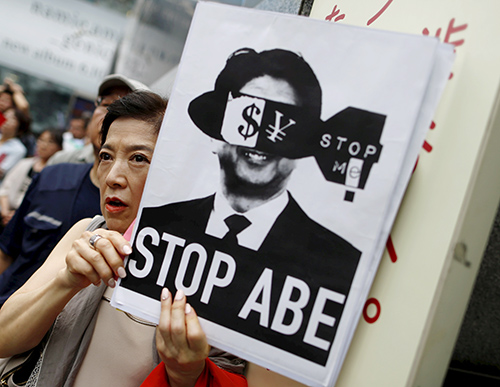
A protester holding a placard participates in a rally against Japanese Prime Minister Shinzo Abe's administration in Tokyo, Japan, June 27, 2015. Hundreds of people joined the demonstration on Saturday against Abe's policies in Tokyo's Shibuya area. [Photo/Agencies] |
At a recent dinner with high-ranking media figures, Japanese Prime Minister Shinzo Abe reportedly said the controversial security bills he had introduced in parliament were aimed at containing China, according to Japan's Gendai Business Weekly.
On Monday, the magazine reported that Japan's "security bills are targeted at China in the South China Sea". On the same day, the "Anti-war Committee of 1000", a Japanese civil group comprising Constitution scholars and authors, submitted a memorandum with more than 1.65 million signatures to the Diet, Japan's parliament, demanding that it withdraw the controversial bill and annul the decision to lift the ban on collective self-defense.
Japan's post-World War II defense system is undergoing structural changes thanks to Abe, who has been relentlessly pushing for the passage of the new security bills. By introducing the bills in the Diet, he is trying to lay the legal basis for Japan's militarization and help the United States contain China.
Prepared with help of the US, Japan's pacifist Constitution came into effect on May 3, 1947, stipulating that the country will not have a full-fledged military or wage a war. Under the Constitution, Japan adopted a defense-only policy which gave its Self-Defense Forces only minimum power and forbade it from engaging in armed conflicts or going on overseas missions. Besides, it banned Japan from exercising the right to collective defense, which many postwar Japanese Cabinets have claimed their country has the right to as a sovereign state.
The positive effect of the restrictions was that Japan emerged on the global stage as a "peace-loving country" and benefited from its new image. Also, Japan's left-wing politicians and scholars, and even many of its ordinary citizens, have adopted pacifism as their motto and made every effort to protect the pacifist Constitution.
But such Japanese citizens' efforts have constantly collided with the interests of hawkish nationalists, which Abe appears to lead. Indeed, Japan should be allowed to make efforts to become a "normal state", but it should do so with good intentions instead of exhibiting a warmongering mentality.
Claiming more than once his devotion to nationalism, Abe seems to be leading Japan away from the path of real independence despite reclaiming the right to chart out a defense policy by reinterpreting the Constitution.
The new security bills are designed to overturn Japan's postwar defense system, leading to fundamental changes in the Japan-US military alliance. Should the Diet pass the bills, Japan's Self-Defense Forces would no longer be restricted by the traditional defensive rules. Instead, they could transform into a real military and expand their operations across the world. And it is highly likely that Japan will use its right to collective defense to make illicit profits, for example, by selling weapons to countries in disputed regions and thus create regional tensions. Also, Japan will have enough reason to fight its close ally the US' war if Abe succeeds in amending the pacifist Constitution.
Japan has reached a tipping point on Abe's ill-considered political choice, which has been criticized by an increasing number of righteous people in Japan, including some of his Liberal Democratic Party colleagues. The public approval rating for the Cabinet has continued to fall, reaching an all-time low of 47.4 percent since Abe was sworn in prime minister for the second time in 2012, according to Kyodo News' latest survey.
But emboldened by the massive majority the ruling LDP-Komeito coalition enjoys in the parliament, Abe seems determined to force the new security bills through the Diet by the end of September. To say he cares nothing about public opposition would be an understatement.
But Abe should know that despite not having any intention of interfering in Japan's internal affairs, regional powers such as China will not sit idle if he continues to sabotage regional peace.
The author is a researcher in Japan studies at the Chinese Academy of Social Sciences.



I’ve lived in China for quite a considerable time including my graduate school years, travelled and worked in a few cities and still choose my destination taking into consideration the density of smog or PM2.5 particulate matter in the region.
Copyright 1995 - . All rights reserved. The content (including but not limited to text, photo, multimedia information, etc) published in this site belongs to China Daily Information Co (CDIC). Without written authorization from CDIC, such content shall not be republished or used in any form. Note: Browsers with 1024*768 or higher resolution are suggested for this site.
License for publishing multimedia online 0108263 Registration Number: 130349