 |
|
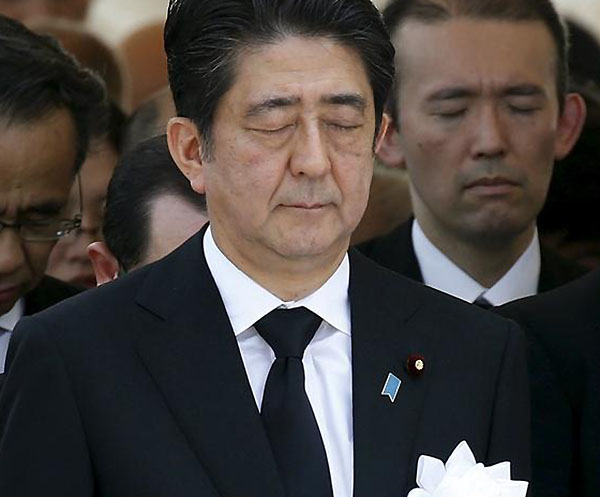
Japan's Prime Minister Shinzo Abe offers a silent prayer for victims of the 1945 atomic bombing, during a ceremony commemorating the 70th anniversary of the bombing of the city at Nagasaki's Peace Park in western Japan, August 9, 2015. [Photo/Agencies] |
Japanese Prime Minister Shinzo Abe on Saturday, the day marking the 70th anniversary of Japan's surrender in World War II, sent a ritual offering to the notorious Yasukuni Shrine in Tokyo, which honors Japan's war dead, including 14 Class-A convicted criminals of WWII. This was just a day after his long-awaited statement to mark the anniversary.
True, Abe did include "deep repentance", "heartfelt apology", "colonial rule", and "aggression" in his 4,000-word statement - much longer than those on the 50th and 60th anniversaries - but he stopped short of offering a direct apology of his own for Japan's wartime atrocities.
In response, China's Foreign Ministry spokesperson Hua Chunying on Friday called on Japan to recognize and reflect on its history of aggression through concrete actions and to follow the path of peaceful development to win the trust of its Asian neighbors and the international community. Park Geun-hye, president of the Republic of Korea, said that Abe's speech contained "regrettable elements".
Given Abe's previous ambiguous artifices when it comes to Japan's war crimes and the role of the Yasukuni Shrine, many have been watching closely to see whether the right-leaning Japanese leader would apologize for the tremendous sufferings that his country caused to the world especially the Asian community. Just two days prior to Abe's statement, the UN Secretary General Ban Ki-moon called on Japan to reflect on its war history in order to move forward.
Unlike then Japanese prime minister Tomiichi Murayama, who expressed in his landmark 1995 statement, his own "deep remorse" and "heartfelt apology", Abe instead used "Japan" in his speech, he further elaborated on his false historical perspective by saying, "we must not let our children, grandchildren, and even further generations to come, who have nothing to do with that war, be predestined to apologize".
The incumbent Japanese leader's lip service to Murayama's heartfelt apology, which avoided mentioning what Japan should do for the time being, reveals his reluctance to apologize even when under great pressure to do so.
Admittedly though, his fine-honed statement did make a few amendments, even improvements, to the Murayama Statement and the one delivered by then prime minister Junichiro Koizumi on the 60th anniversary of the victory of World War II.
For one, Abe made a fresh acknowledgment of the sexual violence during the war, despite failing to directly refer to the about 200,000 "comfort women" from China, the Korean Peninsula and the Philippines, who were forced into sex slavery in Japanese military brothels. He spoke of a host of women whose "dignity and honor were severely injured during wars in the 20th century", which is indeed a step forward for Abe and his predecessors.
Besides, Abe shed new light on Japan's militarist mentality, confessing that Japan launched its war to "overcome its diplomatic and economic deadlock" by force, which he deemed was wrong. His remarks also acknowledged Japan's wartime culpability which made "numerous innocent citizens suffer and fall victim to battles", as well as a commitment that the country will "never again resort to incident, aggression or war", and it will "abandon colonial rule forever".
It is still too early to say whether Abe means his words or not, but his verbally confusing statement will undoubtedly provoke criticism about why he refused to make a proper apology.
More importantly, should Japan truly want to adopt a pacifist path, the Abe administration is obliged to keep its latest promise, which shows rare objective reflections on the country's past crimes and relations with other Asian nations. Therefore, if Tokyo continues to expand its military power and exercise the right to collective self-defense by reinterpreting Japan's pacifist Constitution, the "Abe Statement" will be regarded both at home and abroad as an insincere show under pressure.
The author is a professor at and director of the International Security Research Center affiliated to the PLA International Relations University.



I’ve lived in China for quite a considerable time including my graduate school years, travelled and worked in a few cities and still choose my destination taking into consideration the density of smog or PM2.5 particulate matter in the region.
Copyright 1995 - . All rights reserved. The content (including but not limited to text, photo, multimedia information, etc) published in this site belongs to China Daily Information Co (CDIC). Without written authorization from CDIC, such content shall not be republished or used in any form. Note: Browsers with 1024*768 or higher resolution are suggested for this site.
License for publishing multimedia online 0108263 Registration Number: 130349