 |
|
LI MIN/CHINA DAILY |
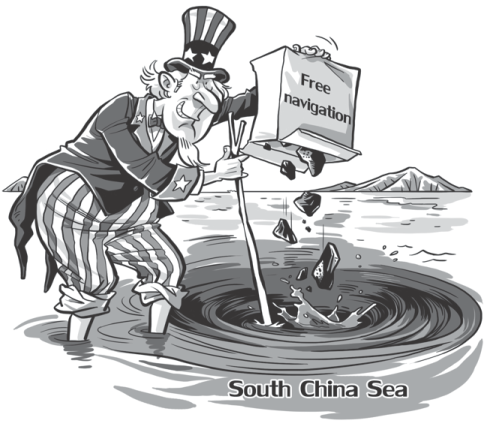
The United States is likely to sail warships close to China's artificial islands in the South China Sea, once again using "free navigation" as an excuse to interfere in the regional territorial disputes. In the past, the US has refrained from sending warships inside the 12-nautical mile zone of China's artificial features, but this time the warships will reportedly do so.
In fact, the US' obsession with free navigation originated with the Truman Proclamation, which was issued by the then-president Harry S. Truman in 1945 to guarantee such freedom in the high seas. In recent decades, Washington has become increasingly focused on the South China Sea, asserting free navigation in the regional waters is a core interest.
Of all foreign military activities in the?exclusive economic zones (especially those of China and the US), the innocent passage of warships through territorial seas, have fueled the majority of clashes and disagreements, as the United Nations Convention on the Law of the Sea fails to provide explicit regulations on such activities. Consensus has seldom been reached on the peaceful use of marine resources and maritime scientific studies in such waters either.
In particular, whether the relevant coastal states should be notified and asked for permission prior to foreign military activities within their special economic zones has become a global concern. It is something on which consensus is unlikely to be reached under the framework of the convention. Not to mention, the US has not ratified the convention yet.
As for Beijing and Washington, they are supposed to engage in bilateral dialogues and negotiations to enhance mutual trust, and abide by the key principles, especially the early notification of major military operations, and their guidelines on behavior to avoid military encounters, which were agreed in November last year.
Being two major players in the Asia-Pacific area, China and the US share the responsibility to improve the management of military activities in the region's economic zones. Likewise, they should deal rationally with their disputes over the innocent passage of warships through territorial waters, which largely depends on providing advance notice.
Indeed, there has no international law on innocent passage recognized by the entire international community, but it is undoubtedly necessary for all foreign warships to obey the relevant local rules and regulations should they attempt to cross other countries' territorial waters, regardless of innocent intentions.
Therefore, both countries should fully analyze their disputes over innocent passage, based on UNCLOS, which stipulates that coastal states have the right to make their own laws and regulations to govern the passage of foreign warships through their territorial waters and safeguard maritime stability.
On its part, China is becoming more active in attempting to resolve the South China Sea issues, namely by launching more construction projects around the Nansha Islands, providing public goods, seeking negotiations to establish a Code of Conduct in the waters and adopting a dual track approach based on consensus with the members of the Association of Southeast Asian Nations that the disputes should be resolved through direct negotiations between disputing parties and peace and stability should be maintained through joint efforts.
The US needs to take a more inclusive and constructive approach to the South China Sea. It should remain neutral on the territorial disputes and stop giving unprincipled protection (military aid, joint drills, defense treaties) to some of its allies, such as the Philippines. If it truly wants to boost the progress that some regional players have made so far in shelving the maritime disparities, instead of further complicating the South China Sea issues, it has to display some sincerity to the international community.
The author is director of the Ocean Strategy Studies Center at the Shanghai Academy of Social Sciences.



I’ve lived in China for quite a considerable time including my graduate school years, travelled and worked in a few cities and still choose my destination taking into consideration the density of smog or PM2.5 particulate matter in the region.
Copyright 1995 - . All rights reserved. The content (including but not limited to text, photo, multimedia information, etc) published in this site belongs to China Daily Information Co (CDIC). Without written authorization from CDIC, such content shall not be republished or used in any form. Note: Browsers with 1024*768 or higher resolution are suggested for this site.
License for publishing multimedia online 0108263 Registration Number: 130349