 |
|
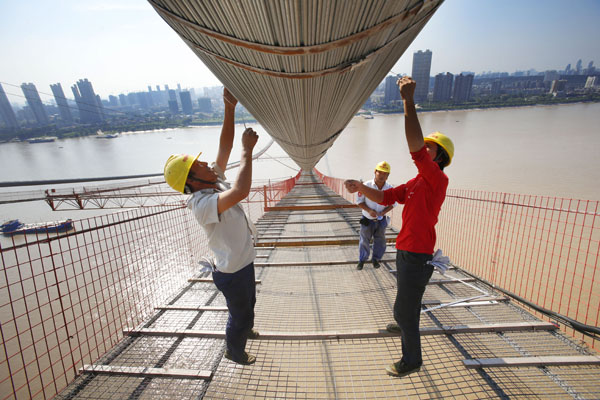
A bridge over the Yangtze River under construction in Wuhan, Hubei province. It will be the eighth Yangtze River bridge in the city and is evidence of ongoing infrastructure development. The country is making preparations for drafting the next five-year economic development plan (2016-20), which may put emphasis on boosting domestic demand. [Photo/China Daily] |
With the introduction of the 12th Five-Year Plan (2011-15), China began a new stage of consumption, undergoing the transformation from a society dominated by the consumption of daily necessities to one characterized by the consumption of services.
The added-value of the tertiary industry accounted for 49.5 percent of the GDP in the first half of 2015, and it is expected to surpass 50 percent by the end of the year. This will be 3 percentage points higher than the goal set during the 12th Five-Year Plan.
That means two significant changes have happened. The first is that the tertiary industry accounts now for a bigger share of GDP than the second industry, and domestic consumption is contributing to the country's economic growth.
This transformation of the economic structure is expected to further accelerate as China goes all out to establish consumption-powered growth during the coming 13th Five-Year Plan (2016-20).
However, since China's consumption rate now stands at 50 percent, 30 percentage points lower than the average level in developed countries, it is unlikely to experience overconsumption as is the case in the United States.
The diversified and Chinese characteristics of its consumption structure mean the country still has huge potential to expand domestic demand. For example, the current consumption capacity of China's elderly people is estimated to total 1 trillion yuan ($157.5 billion). However, due to the insufficient supply of tailor-made products and services, the annual spending by this ever-enlarging group is only about 200 billion yuan at present. The accelerating changes in China's demographic structure and its ongoing urban-rural integration are robustly driving domestic consumption.
With the implementation of a series of consumption-prioritized policies and measures, China's consumption is expected to have doubled when the 13th Five-Year Plan matures. It is expected that the country's final consumption rate will rise from 51.2 percent in 2014 to above 60 percent by the end of the five-year period, and its household consumption rate will rise to 50 percent. The proportion of the country's household consumption to its gross domestic product has been on a declining trajectory, falling from 48.8 percent in 1978 to 36.2 percent in 2013, in contrast to relatively stable government spending.
It is expected the country's total consumption will increase from 30.7 trillion yuan in 2014 to 50 trillion yuan by 2020. Increased spending will make a bigger contribution to the country's economic growth, which is expected to be over 60 percent by 2020. China's huge consumption market not only constitutes an important prop for its own economic growth, it will also be an important propulsive force for the world's economic rebalancing as a whole.
In the coming 13th Five-Year Plan period, the country should accelerate its much-needed economic transformation led by the service sector. Deeper integration between the industrial and service sectors, such as the informationalized, service-oriented and globalized development of the manufacturing sector, is irreversible trend. Developing modern services will not play down the importance of industry. On the contrary, the development of modern services driven by the new industrial revolution will lubricate the development of emerging industries. Furthermore, consumption expansion resulting from a booming service sector will also promote more effective investment, thus pushing forward investment transformation that will also drive economic growth.
Given that the 13th Five-Year Plan period is in the middle and later period of China's industrialization, the push for a transformation of the economy from industry-dominated to services-led is thus an intrinsic requirement for China's economic restructuring and upgrading, and also a key for releasing its enormous consumption potential.
The country should fully open its service market, as this is not only a key to its economic structural adjustment, but also a strategic direction for its market-based reform efforts. China has opened the majority of its industries over the past decades since the launch of reform and opening-up, but its service market has remained insufficiently opened, thus making it difficult for the sector to realize further development and enhancement through utilization of domestic and overseas capital.
The country should accelerate its financial, tax, fiscal and educational reforms in a bid to break the structural obstacles to development of the service sector. At the same time, the government should increase the purchases of public services as a way to accelerate the opening of the country's public service market.
The author is president of the China Institute for Reform and Development.



I’ve lived in China for quite a considerable time including my graduate school years, travelled and worked in a few cities and still choose my destination taking into consideration the density of smog or PM2.5 particulate matter in the region.
Copyright 1995 - . All rights reserved. The content (including but not limited to text, photo, multimedia information, etc) published in this site belongs to China Daily Information Co (CDIC). Without written authorization from CDIC, such content shall not be republished or used in any form. Note: Browsers with 1024*768 or higher resolution are suggested for this site.
License for publishing multimedia online 0108263 Registration Number: 130349