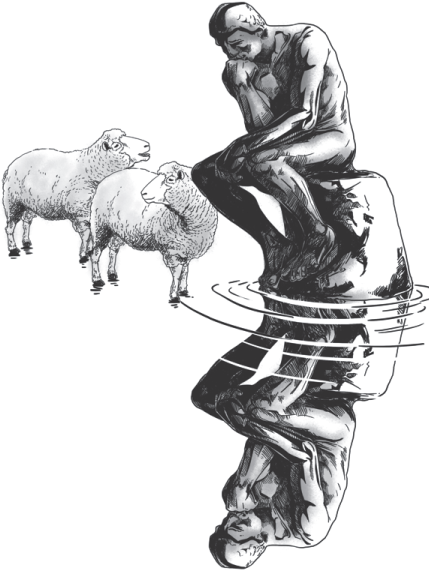
Editor's note: China's Boya Biotech has announced that it will join hands with Sooam Biotech of the Republic of Korea to build the largest cloning facility in Tianjin. Their goal is to "produce" 1million cloned oxen every year, plus dogs and even some endangered species. According to some recent reports, Boya Biotech board chairman has said the company is "improving" the primate-cloning technology but it will not clone humans in deference to public sentiment. The opinions of two science writers on the subject follow:
Ethical concerns over cloned animals
Unlike natural reproduction, in which the newborn has the genes of both parents and thus can be different from both, cloned animals get their genes from only one and are therefore rather vulnerable.
Dolly the sheep, the first cloned animal, was born in Scotland in 1996. Sixteen years later, the Nobel Prize for Medicine was awarded to John B. Gurdon and Shinya Yamanaka for proving that specialized cells, too, can be reprogrammed to become any kind of tissue for the body.
Cloning can help produce more animal products to meet market demands. Animal products here mean more than food and fur. Some cloned animals can produce trans-genetic products, like certain kinds of protein that can be used as medicine. Cloning can also save some endangered species from extinction. And for some people rich enough to afford it, cloning can "gift" them "copies" of their beloved dead pets.
The first pet was cloned in the Republic of Korea back in 2008. But all attempts to commercialize animal cloning in China have failed, perhaps because cloned animals tend to die rather young.
Also, since there is no evidence either to verify or to falsify the safety claims of food products made from cloned animals, wide-spread concern over their safety is understandable.
The cloning of pets too has come in for criticism, especially on animal welfare grounds. One cloned pet dog can "consume" about 80 other dogs because only one in scores of cloned embryos is likely to survive, and the female dogs carrying the "failed" embryos will abort, which could prove fatal for some of them. Hence, cloning is not only expensive but also raises ethical concerns.
The UK Royal Society for the Prevention of Cruelty to Animals has long been accusing those cloning pet animals of cruelty. And in September, the European Parliament passed a bill banning the cloning of cattle or selling of cloned cattle meat, because cloned animals are more prone to health problems. Will the cloning facility in Tianjin face the same problem? We have to wait for the answer.
Zhang Tiankan is deputy editor-in-chief of Encyclopedic Knowledge and a former research scholar at the Chinese Academy of Medical Sciences.



I’ve lived in China for quite a considerable time including my graduate school years, travelled and worked in a few cities and still choose my destination taking into consideration the density of smog or PM2.5 particulate matter in the region.
Copyright 1995 - . All rights reserved. The content (including but not limited to text, photo, multimedia information, etc) published in this site belongs to China Daily Information Co (CDIC). Without written authorization from CDIC, such content shall not be republished or used in any form. Note: Browsers with 1024*768 or higher resolution are suggested for this site.
License for publishing multimedia online 0108263 Registration Number: 130349