 |
|
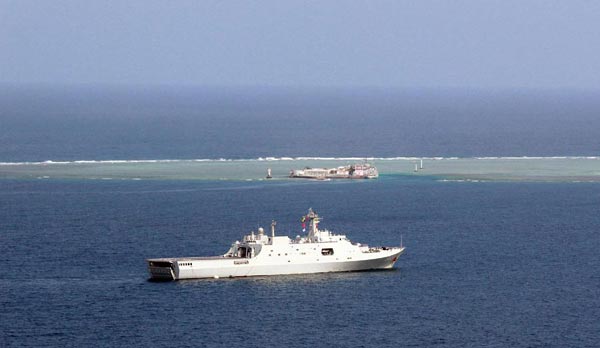
A formation of the Nanhai Fleet of China's Navy on Saturday finished a three-day patrol of the Nansha islands in the South China Sea. [Photo/Xinhua] |
The Philippines has lately been selling the South China Sea arbitration case it unilaterally initiated to the international community while defaming China, claiming that China's non-acceptance of and non-participation in the arbitration undermines international rule of law. Such moves are best captured by a Chinese saying: the guilty party filing the suit first. The Philippine side is misleading public opinion by playing the "victim" in the arbitration farce it started in an attempt to cover up its moves that violate international law and trample upon international legal order in pursuit of illegal interests for itself. Non-acceptance of and non-participation in the arbitration is the move China has made to safeguard the international rule of law.
China's non-acceptance of and non-participation in the arbitration is to uphold the sanctity of the United Nations Convention on the Law of the Sea (UNCLOS). UNCLOS does not apply to territorial disputes at all. Furthermore, China's declaration in accordance with UNCLOS in 2006 excludes disputes concerning maritime delimitation from arbitral proceedings. Undeniably, the dispute between China and the Philippines is in essence a dispute over territorial and maritime delimitation issues. In fact, the Philippines' initiation of the arbitration, in total disregard of international law and the spirit of UNCLOS, undermines the authority and sanctity of the Convention. In response to the Philippines' illegal moves, China refuses to "dance with it", and follows the policy of not accepting or participating in the arbitration. This position testifies to China's strong sense of responsibility, and is the righteous act China has taken to defend the legitimate rights and interests of a State Party to UNCLOS and to uphold the authority and sanctity of this international instrument.
China's non-acceptance of and non-participation in the arbitration is to honor the joint commitment it has made with the Philippines. The two sides reached consensus a long time ago on how to address the dispute. China and the Philippines have issued joint statements and news releases on multiple occasions and they both signed the Declaration on the Conduct of Parties in the South China Sea (DOC), in which the two sides have pledged to settle disputes through friendly negotiations and consultations. By unilaterally initiating the arbitration, the Philippines has negated its solemn commitment to its neighbors and the international community, and breached one of the core principles in international relations — Pacta sunt servanda ("agreements must be kept"), thus jeopardizing its own international credibility. By contrast, China's position of not accepting or participating in the arbitration demonstrates that it is true to its words.
China's non-acceptance of and non-participation in the arbitration is to uphold its lawful rights and interests. China has sovereignty over the South China Sea Islands and lawful rights and interests in the South China Sea. No one, no country and no entity but the Chinese government has the right to make the decision on behalf of the 1.3 billion Chinese people. The Philippines chose to illegally occupy some of China's islands and reefs in the South China Sea first, and then, file the case against China instead. Its purpose is no other than to cover up its illegal moves. China will not condone such illegal actions. China's position of non-acceptance of and non-participation in the arbitration is legitimate and justified.
China's non-acceptance of and non-participation in the arbitration conforms with the general practice in addressing international disputes. National consent is the very core and soul of international law. The key to resolving disputes over territory and maritime rights and interests is for parties directly concerned to reach consensus ad idem. The Philippines' unilateral initiation of arbitration is by no means aimed at resolving the dispute. Rather, it is to further complicate the situation and to vilify China. What the Philippines is doing is an out-and-out political provocation. By contrast, China's way of addressing disputes over territory and maritime rights and interests through bilateral consultations and negotiations has proven effective. As a matter of fact, China has properly settled land boundary issues with 12 countries and completed the delimitation of maritime boundary in the Beibu Bay with Vietnam. China will continue to follow its current practice and will not accept arbitration as a way to settle disputes over territory and maritime rights and interests.
China is firmly committed to upholding and building the international rule of law. The Philippine's unilateral initiation of arbitration regarding the South China Sea is purely an attempt to sabotage the international rule of law and encroach upon China's rights and interests under the cloak of international law. China's non-acceptance of and non-participation in the arbitration is a lawful and sensible response to the illegal moves of the Philippines. In addressing the South China Sea disputes, it is of no use to employ treacherous means, scare-mongering or slandering, or resort to a third party. The only viable way forward is for the Philippines to admit its mistake, change its course, and return to bilateral negotiations and consultations.
The author is a researcher on international studies.



I’ve lived in China for quite a considerable time including my graduate school years, travelled and worked in a few cities and still choose my destination taking into consideration the density of smog or PM2.5 particulate matter in the region.
Copyright 1995 - . All rights reserved. The content (including but not limited to text, photo, multimedia information, etc) published in this site belongs to China Daily Information Co (CDIC). Without written authorization from CDIC, such content shall not be republished or used in any form. Note: Browsers with 1024*768 or higher resolution are suggested for this site.
License for publishing multimedia online 0108263 Registration Number: 130349