 |
| LI MIN/CHINA DAILY |
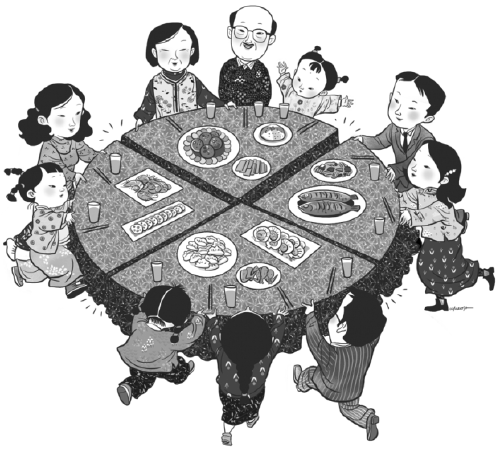
For most Chinese people who work far from home, the Spring Festival holiday offers a rare time for a get-together with relatives and friends. This is also a good occasion for promoting social and interpersonal interactions.
Chinese people are famous for "scrambling with relatives and friends to pay the bill" for dinners in restaurants; normally, the elders are known to pick up the tab saying "it is my treat". But this seems to be changing, as Chinese people, particularly those born in the 1980s and 1990s, become more receptive to Western culture. The younger generations no longer detest sharing expenses. And even though not all choose to "go Dutch", an increasing number of them have become tolerant to such proposals.
However, it seems that "going Dutch" is not something all Chinese people can accept easily. The way a woman in Wuhan, Hubei province, recently reacted to going Dutch reflects how unpopular the concept of sharing the bill still is in Chinese society.
According to media reports, the woman surnamed Li, traditionally her brothers and sisters, who now have their own families, should take turns to pay for the annual family reunion dinner during the Lunar New Year, and this year one of her brothers should have footed the bill. But the brother proposed that all members of the big family, including the elders and children, pay their share for the dinner starting from this year.
She said that after the dinner, each diner paid about 100 yuan ($15.17) as part of his/her share and left the restaurant sullenly, regretting that the otherwise harmonious "family reunion dinner" atmosphere was ruined by the go-Dutch arrangement.
One wouldn't be mistaken for saying that the Wuhan woman represents many Chinese people's views or disapproval of the go-Dutch model. Many Chinese people, who cherish collective unity and love, and value kinship and camaraderie, believe the talk of "money" among family members, relatives and friends is uncalled for. Going Dutch at a family gathering is embarrassing, they say, because it could lead to alienation, instead of bringing them closer.
The controversy over going Dutch is not because some people have or do not have a sense of belonging when it comes to relatives and friends. What it essentially embodies is a different concept toward sharing expenses, which traditionally is considered demeaning.
But the "taking-turns-to-pay" model the Wuhan woman approved of is another kind of go-Dutch arrangement, although no one wants to admit it. For friends who have dinner together regularly, there is not much difference between everyone taking turns to pay and each paying his or her own bill, and the difference, if there is any, is only a more direct or indirect cost-sharing arrangement. So it is difficult to judge which is better.
As a matter of fact, sharing the bill is becoming increasingly popular in modern Chinese society, especially among young people in big cities. Aside from the dinners that friends have together, many young couples even choose to have separate bank accounts and go Dutch in their daily expenses. There is no evidence to show couples that choose such a lifestyle love each other less or their marriage is less stable than that of those who lead life according to established traditions.
An online survey shows 70 percent of the netizens do not detest going Dutch, although 77 percent Chinese disapprove of the "expense-sharing" model between couples. And according to a 2015 survey by a public opinion agency under Shanghai's bureau of statistics, nearly 30 percent of the respondents are not averse to going Dutch for household expenses.
No matter whether or not we accept it, going Dutch is only an expense-sharing arrangement that appears a bit different from the traditional Chinese cost-sharing model. The need for us is to make an informed choice.
The author is a senior writer with China Daily.



I’ve lived in China for quite a considerable time including my graduate school years, travelled and worked in a few cities and still choose my destination taking into consideration the density of smog or PM2.5 particulate matter in the region.
Copyright 1995 - . All rights reserved. The content (including but not limited to text, photo, multimedia information, etc) published in this site belongs to China Daily Information Co (CDIC). Without written authorization from CDIC, such content shall not be republished or used in any form. Note: Browsers with 1024*768 or higher resolution are suggested for this site.
License for publishing multimedia online 0108263 Registration Number: 130349