 |
|
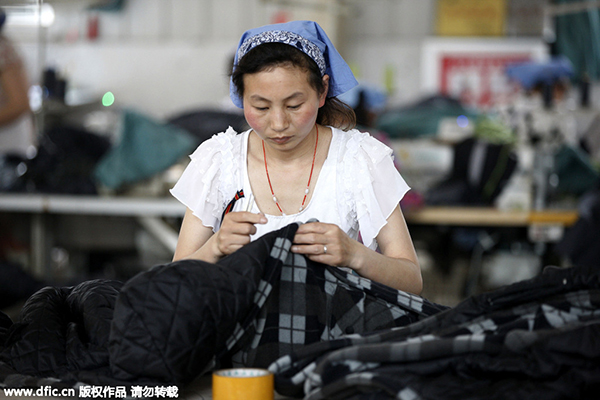
A female Chinese worker sews clothes at a garment factory in Huaibei city, East China's Anhui province, June 1, 2015. [Photo/IC] |
There are more than a few financial figures in China that no longer trust Western financial advice (or most advisers) any more than they have to. There is a rich, as it were, history behind the mistrust. And in this, George Soros, no less, has a role.
We start our narrative with the Asian financial crisis of the late 1990s. For years, China had been relentlessly advised by some prominent experts in the West to stop babying its coddled currency and let it go outdoors onto the international markets to play fair and square with other big-time currencies. For decades this has been the constant whining pitch of the geek chorus in the West.
In fact, the argument has merit if China is to secure its place in the competitive world marketplace. And years later, Beijing actually moved in exactly that direction, in part to satisfy the International Monetary Fund that its currency would be freely usable and so globally market-worthy. But two decades ago, China, then not ready for the big bad sandbox, felt rushed by the West and so held back.
Surprise: Suddenly a vile regional currency crisis swept across Asia. Western speculators, allegedly including Soros (in 1992, he hit his billionaire jackpot with a nervy mega-plunge against the sodden British pound), dumped bundles of cash on the bet that weak Asian currencies would lose value, and pocketed fortunes via massive "shorting" campaigns that in effect pulled down Asian currencies even more.
China, whose renminbi-exposure caution was then working to great benefit, escaped all that pain. So did our more globally sensitive Western souls who were unnerved by the global turbulence, by the frailty of the fraying "international economic architecture" - and by the heartless display of sheer amoral speculative greed at the expense of the Asian people.
After all, everyone knew that massive currency speculation can rock even relatively well-managed small- and medium-sized economies - just as easily as a tsunami can overwhelm the most competently installed roofing over a house. As a mega-investor turned philanthropist, Soros knew well of what he spoke when he depicted predatory financial speculators as the destructive "al-Qaida" (his words) of the financial world.
And so sure enough, in 2008 - only a decade after the near-death experience of the Asian financial crisis - the US economy almost collapsed into depression.
The reason: a new financial "al-Qaida" investment house of cards known as the "subprime" credit default crisis. For a quick primer on subprime, see Hollywood film The Big Short. I am serious, because you cannot afford to miss pop star Selena Gomez explaining "synthetic" CDOs.
With the ground shaking from the United States financial earthquake, China then used massive stimulus to bail out its economy. While this bold move ran the risk of inserting bubbles into the Chinese economy that down the road might inevitably lose their pop, some Western financial figures, including Soros, applauded the "flash-flood stimulus".
A China shaken by the US housing collapse greatly appreciated that support. But that was then, and this is now - so guess what? The other day Beijing rhetorically unloaded on speculators who might have thoughts of wanting to "bet on the 'ultimate failure' of the suddenly rocky Chinese economy" (in the words of Xinhua, which added), "Reckless speculations and vicious shorting will face higher trading costs and possibly severe legal consequences."
Where did that outburst come from? It turns out that at the recent annual retreat in Davos, one famed Western figure airing the view that China is "doomed to a crash" was Soros himself. While the old "shorting" master is no longer active (and surely Xinhua must know this), in some eyes he remains the international icon (for all his commendable philanthropy) of sadistic currency and equity profiteering. People's Daily said: "A Soros' war on the renminbi and the Hong Kong dollar cannot possible succeed - about this there can be no doubt."
These warnings are really directed generically rather than individually - at the global class of fast-buck investment jackals that care for no one's welfare other than their own.
The author is distinguished scholar of Asian and Pacific studies at Loyola Marymount University in Los Angeles.



I’ve lived in China for quite a considerable time including my graduate school years, travelled and worked in a few cities and still choose my destination taking into consideration the density of smog or PM2.5 particulate matter in the region.
Copyright 1995 - . All rights reserved. The content (including but not limited to text, photo, multimedia information, etc) published in this site belongs to China Daily Information Co (CDIC). Without written authorization from CDIC, such content shall not be republished or used in any form. Note: Browsers with 1024*768 or higher resolution are suggested for this site.
License for publishing multimedia online 0108263 Registration Number: 130349