 |
|
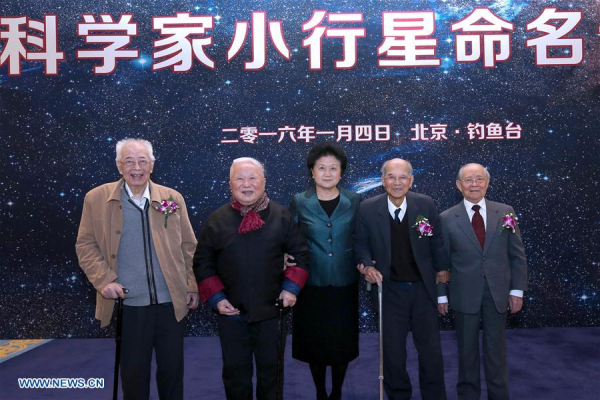
Chinese Vice Premier Liu Yandong (C) poses for a photo with scientists Xie Jialin (2nd R), Wu Liangyong (2nd L), Zheng Zhemin (1st R) and Zhang Cunhao (1st L) during the naming ceremony for five minor planets in Beijing, capital of China, Jan. 4, 2016. Five minor planets have been named after top Chinese scientists, including the country's first Nobel laureate scientist Tu Youyou, renowned physicist Xie Jialin, architect and educator Wu Liangyong, prominent dynamicist Zheng Zhemin and founder of the field of high-energy chemical lasers Zhang Cunhao. The naming was proposed by the National Astronomical Observatories of the Chinese Academy of Sciences and approved by the International Astronomical Union Minor Planet Center. [Photo/Xinhua] |
At its Feb 17 meeting, the State Council, China's Cabinet, announced a range of measures, which, among other things, supports the conversion of scientific and technological achievements into practice and promotes scientific and technological development, in order to boost economic growth. Some media outlets' comments on the issue follow:
China Youth Daily:
The support of the State Council for the novel method is encouraging given that the conversion ratio in this field is rather low.
Statistics show the applications for patents and their authorizations in China are the highest and second-highest in terms of numbers. But quite a few results of research have long been confined to laboratories, instead of being used for practical purposes. In their quest for scientific and technological fruits, frontline scientists and technologists often encounter institutional obstacles such as the lack of incentives, difficulties in converting research results into shareholding as well as the risk of causing loss to State-owned assets.
The major targeted measures confirmed by the State Council are aimed at activating latent scientific and technological results and creating a clear and smooth channel for their practical use to form a new productive force as soon as possible. Such conversion is important for the supply-side structural reform and the implementation of an innovation-driven development strategy.
Youth.cn:
A country's economic strength is, in the final analysis, decided by its scientific and technological power.
At a time when China is fast losing its decades-long "demographic dividend" and its economic growth has slowed down, efforts to accelerate the conversion of the results of scientific and technological research into practical gains, and allow science and technology to play a bigger economic role, are a choice keeping long-term benefits in mind.
Despite the large number of patents that Chinese companies have applied for, many of them have failed to put them to practical use. The commercial status of many a patent is not high and, because of lack of an effective incentive mechanism and a reasonable interest allocation regime, research personnel are not motivated to pursue innovation further.
The State Council meeting's vow to raise the incomes of scientists and technologists by adjusting the income distribution mechanism will act as a driving force for innovation.
CNR.cn:
The State Council has announced a wide range of policy measures to facilitate the conversion of scientific and technological results into practical use to boost innovation.
The conversion of the scientific and technological results has been self-decided without the need to gain approvals from relevant departments. The incomes stemming from such kind of transfers will be fully retained by the institutions that use the research results, mainly for further research. Also, individuals will get a considerable share of the revenues. All these measures are likely to help boost researchers' enthusiasm.
If a patent, or intellectual property right, is not converted into economic gains, it would be useless and a lot of national resources for scientific and technological innovation would be wasted. The push for research results to boost economic development with the help of feasible policies will lubricate the conversion of IPRs into effective patents.
This is the first time that China has included scientific and technological results into the market-based distribution of resources. To more effectively convert such fruits into IPRs or patents, market factors should be given full play and relevant resources distributed according to social demands in a market-propelled environment.


Copyright 1995 - . All rights reserved. The content (including but not limited to text, photo, multimedia information, etc) published in this site belongs to China Daily Information Co (CDIC). Without written authorization from CDIC, such content shall not be republished or used in any form. Note: Browsers with 1024*768 or higher resolution are suggested for this site.
License for publishing multimedia online 0108263 Registration Number: 130349