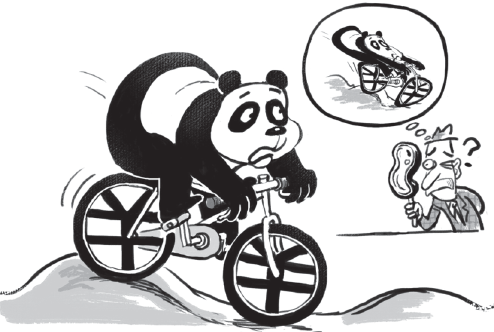
In the run-up to a major policy decision in China, editorials by high-ranking authorities in major publications, as well as reports and communiqués from official forums and meetings, almost always provide clues to what could happen. You just have to know how to read them.
That is easier said than done, at least for foreign media, whose struggle to anticipate China's policy moves has fueled much frustration - and even accusations that Chinese decision-making is secretive and unpredictable. This struggle is perhaps most apparent today in discussions about China's exchange rate.
Many investors interpreted last August's unexpected devaluation of the yuan by 1.9 percent against the US dollar - the first decline following years of steady appreciation - as a last ditch effort by the People's Bank of China to stave off an economic crash. They thus assumed that it was just the beginning of a protracted policy-induced depreciation. As a result, a wave of investors shorted the yuan, fueled exchange-rate volatility and drove a sharp increase in capital outflows.
But China is not really on the verge of a currency crisis. Given that all of this activity is taking place in the offshore yuan market, which is small in scale and has only limited connections to China's financial system - the result of China's hesitancy about financial-market liberalization and capital-account convertibility - the situation remains controllable. Add to that China's other strengths - annual GDP of more than $10 trillion, a growth rate at least 4 percentage points higher than the global average, over $3 trillion in foreign exchange reserves, a savings rate of 40 percent of GDP, and a massive trade surplus - and an exchange-rate crisis seems highly unlikely.
That, however, does not mean there are no risks. On the contrary, China has a strong interest in curbing the volatility and, because of China's centrality to the global economy, so does the rest of the world. The key will be to get markets and policymakers on the same page.
So far, China's leadership has been quite forthcoming about its plans, declaring publicly that substantial devaluation of the yuan is not part of its plan. Owing to the enduring strength of China's economic position, their words should be taken at face value.
Moreover, Chinese policymakers have shown a clear commitment to minimizing government intervention and promoting a market-oriented approach for setting interest and exchange rates. And the authorities - particularly those at the PBoC - have made significant progress toward this end.



I’ve lived in China for quite a considerable time including my graduate school years, travelled and worked in a few cities and still choose my destination taking into consideration the density of smog or PM2.5 particulate matter in the region.
Copyright 1995 - . All rights reserved. The content (including but not limited to text, photo, multimedia information, etc) published in this site belongs to China Daily Information Co (CDIC). Without written authorization from CDIC, such content shall not be republished or used in any form. Note: Browsers with 1024*768 or higher resolution are suggested for this site.
License for publishing multimedia online 0108263 Registration Number: 130349