 |
|
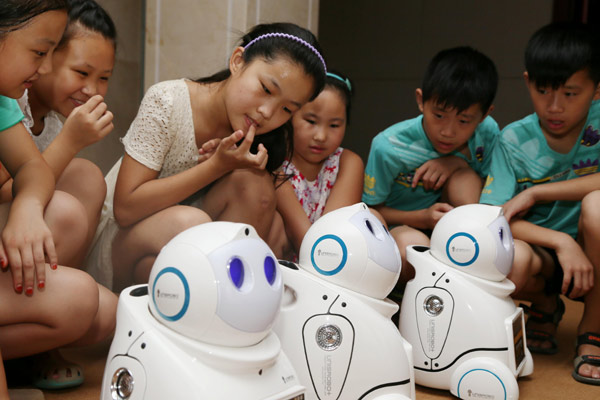
Students watch intelligent robots. [Photo / Provided to China Daily] |
Over the last 30 years, consumers have reaped the benefits of dramatic technological advances. In many countries, most people now have in their pockets a personal computer more powerful than the mainframes of the 1980s. The Atari 800XL computer that I developed games on when I was in high school was powered by a microprocessor with 3,500 transistors; the computer running on my iPhone today has 2 billion transistors.
Even with these massive gains, we can expect still faster progress, as the entire planet-people and things-becomes connected. Already, 5 billion people have access to a mobile device, and more than 3 billion people can access the internet. In the coming years, 50 billion things-from light bulbs to refrigerators, roads, clothing, and more-will be connected to the internet as well.
Every generation or so, emerging technologies converge, and something revolutionary occurs.
Now we are on the cusp of another major convergence: big data, machine learning, and increased computing power will soon make artificial intelligence ubiquitous.
AI follows Albert Einstein's dictum that genius renders simplicity from complexity. So, as the world itself becomes more complex, AI will become the defining technology of the 21st century, just as the microprocessor was of the 20th century.
Consumers already encounter AI on a daily basis. Google uses machine learning to autocomplete search queries and often accurately predict what someone is looking for. Facebook and Amazon use predictive algorithms to make recommendations based on a user's reading or purchasing history.
AI is also the central component in self-driving cars and in game-playing systems such as Google DeepMind's AlphaGo.
Given the wide applications of AI, all companies today face an imperative to integrate it into their products and services; otherwise, they will not be able to compete with companies that are using data-collection networks to improve customer experiences and inform business decisions. The next generation of consumers will have grown up with digital technologies and will expect companies to anticipate their needs and provide instant, personalized responses to any query.
So far, AI has been too costly or complex for many businesses to make optimal use of it. It can be difficult to integrate into a business's existing operations, and historically it has required highly skilled data scientists. As a result, many businesses still make important decisions based on instinct instead of information.
This will change in the next few years, as AI becomes more pervasive.
But to deploy AI effectively, companies will need to keep privacy and security in mind. Because AI is fueled by data, the more data the machine gains about an individual, the better it can predict their needs and act on their behalf. But, of course, that massive flow of personal data could be appropriated in ways that breach trust. Companies will have to be transparent about how they use people's personal data. AI can also be used to detect and defend against digital security breaches, and will play a critical role in protecting user privacy and building trust.
As in past periods of economic transformation, AI will unleash new levels of productivity, augment our personal and professional lives, and pose existential questions about the age-old relationship between man and machine. It will disrupt industries and dislocate workers as it automates more tasks. But just as the internet did 20 years ago, AI will also improve existing jobs and spawn new ones. We should expect this and adapt accordingly by providing training for the jobs of tomorrow, as well as safety nets for those who fall behind.
AI is still a long way from surpassing human intelligence. But we can count on AI becoming like electricity-invisible and augmenting almost every part of our lives.
The author is CEO of Salesforce, a cloud computing company.
Project Syndicate



Copyright 1995 - . All rights reserved. The content (including but not limited to text, photo, multimedia information, etc) published in this site belongs to China Daily Information Co (CDIC). Without written authorization from CDIC, such content shall not be republished or used in any form. Note: Browsers with 1024*768 or higher resolution are suggested for this site.
License for publishing multimedia online 0108263 Registration Number: 130349