With poll win, Abe reaches endgame of his gamble
 |
|
Japan's Prime Minister Shinzo Abe, who is also leader of the Liberal Democratic Party (LDP), attends a news conference at LDP headquarters in Tokyo, Japan October 23, 2017. [Photo/Agencies] |
Japanese Prime Minister Shinzo Abe got a phone call from his British counterpart Theresa May on Oct 23, who congratulated him on his win in the general election. May lost overall majority in the British parliament after taking an extraordinary gamble of calling a snap election in June to take advantage of what she perceived to be a weak opposition. Now, she is running a government with the support of Northern Ireland's Democratic Unionist Party.
Abe's political opportunism, on the other hand, has paid off. His ruling coalition won two-thirds of the seats, or super majority, in the lower house of Japan's parliament in the Oct 22 snap election. As a result, Abe could stay in power until autumn 2021 and bid for a third term for the Liberal Democratic Party's leadership race in September 2018.
The LDP won the same number of seats, 284, that it had before Abe dissolved the parliament on Sept 28. But its junior partner, the Komeito, suffered a blow, with its share dropping from 35 to 29. The centrist party's coalition with the center-right LDP, which has been criticized for ramming a series of controversial bills through parliament in the past almost five years, has eroded the Komeito's public support.
The low turnout and flagging popularity of opposition parties worked in favor of the LDP. Only 53.68 percent of the voters, as the Japanese Ministry of Internal Affairs and Communications said, cast their ballots on Oct 22, which was the second-lowest turnout since World War II.
The opposition's efforts to get to the bottom of Abe's cronyism scandals involving two school operators-Moritomo Gakuen and Kake Educational Institution-were halted due to the election. And many voters say Abe has not provided detailed explanations to prove wrong the accusations of his involvement in the two scandals. Support for Abe, battered by the scandals and voters' perception that he took them for granted, dived from 60 percent earlier this year to 26 percent by the end of July.
So when parliament convenes again, opposition lawmakers will likely continue grilling Abe for his alleged involvement in the scandals.
The Asahi Shimbun has rightly termed the election result "a defeat of the opposition parties" rather than a victory of the ruling camp. Half of the voters who support Abe do so, as NHK polls showed, because there is no alternative. The ideologically divided opposition parties, which were caught unprepared, could not come up with any convincing pledge to garner voters' support.
The LDP's control of postwar Japan has been nearly absolute, broken only by a short-lived coalition government of opposition parties in 1993-1994 and by the 2009 victory of the Democratic Party of Japan, which was in power till 2012.
Japanese people want to see a balance of power between the ruling and opposition camps, because when the ruling camp enjoys an overwhelming majority in parliament, as even the pro-Abe newspaper Yomiuri Shimbun argued, a fragmented opposition cannot hope to act as an effective watchdog. "The situation inevitably erodes the healthy and necessary tension in politics," Yomiuri Shimbun said.
Still, any misstep by the new Abe Cabinet will cause his approval ratings to fall again.
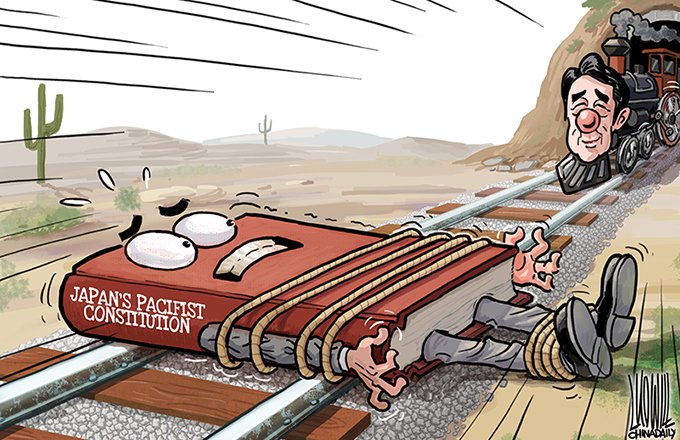
Abe has pressing policy issues such as the economy, a low birth rate and an aging society to handle, and he is eager to make his dream of amending the country's Constitution come true while he is in power.
Opinion polls showed that more than 80 percent of the newly elected members of the lower house support constitutional revision while the public is still divided on the issue. This means the LDP's constitutional amendment proposal may be passed in parliament but fail in a national referendum.
Knowing that he has lost much of his popularity, Abe vowed at a press conference on Oct 23 to run his new administration "humbly and sincerely", because he will not get another chance to take a gamble.
The author is China Daily Tokyo bureau chief. caihong@chinadaily.com.cn