Urumqi attractions
Updated: 2014-08-14 11:01
(www.chinahighlights.com)
|
|||||||||||


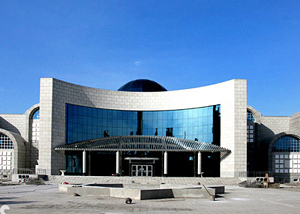
Xinjiang Museum
Feature
 |
|
Xinjiang Uygur Autonomous Region Museum |
1. Recently discovered Ancient Caucasian mummies and their artifacts that are part of one of the biggest archeological discoveries in a hundred years.
2. The Caucasian mummies and artifacts are a hit wherever they go around the world
3. There are also displays of silks and writing in various languages from various eras, and other artifacts of various eras and peoples.
4. Dried food that dates from the Tang Dynasty era or about 1,200 years ago. You can see what people ate then, but you can't taste it! It is strange how things are preserved in the earth in Xinjiang.
Overview
If you are interested in learning about Xinjiang and its history, one of the highlights of Urumqi is the Xinjiang Uygur Autonomous Region Museum. It is one of Urumqi's three main historical museums. There is also a geological and paleontological museum in the city.
The Autonomous Region Museum is famous for having the artifacts and mummies of Caucasians who lived in the region between 1,500 and 4,000 years ago. There is also a collection of silk articles and other artifacts from various eras of history, as well as written materials in different languages. The museum also instructs on the customs of the ethnic groups in the region. What most tourists want to see are the mummies and their artifacts. They are unusually well preserved. Until two decades ago, this culture was hardly known to historians and archeologists, and their history and origins are still mysterious. The Xinjiang Autonomous Regional Museum houses the mummies and their artifacts that are some of the most significant archeological discoveries in a hundred years, and it is a place to learn about the region.
The many Caucasian graves and bodies that have been found around the region are mysterious because little is known about them, and it isn't clear whether they were all descended from the same groups or tribes. The bodies and artifacts of Caucasians date from the Bronze Age 4,000 years ago to the Silk Road era 1,500 years ago. Maybe some of the later mummies were simply travelers or traders in the area.
It is clear that there were settlements of Caucasians about 3,000 and 4,000 years ago that predate by about 1,000 years any evidence of Mongoloid people. This suggests that the original settlers in the region were Caucasians. The earliest inhabitants had a culture like a European culture. The Caucasian people who lived during the Silk Road era from about 1 AD to 1,000 AD wrote in an Indo-European language called Tocharian. Some texts and inscriptions have been found as well as paintings of Caucasian people.
The three or four mummies and the artifacts that are displayed are thought to be part of one of the biggest archeological discoveries of the past hundred years. They shed new light on the ancient history of Eurasia. It wasn’t known that this culture existed until about twenty years ago. It was thought that Caucasians mainly lived in Europe. DNA testing on certain mummies showed that they were related to Scandinavians, and their woolen clothing was found to be similar in make and style to clothing from the same period in Europe. The blond mummies look Scandinavian. There are also many red and brown haired mummies. Red hair was thought to be typical of Celts but not Scandinavians. The clothing and artifacts that have been studied in the last few years show that their technology was more advanced than thought possible for Asia at that time. So in the last few years, historians have had to rewrite the history of Eurasia. It is obvious that Central Asia was linked culturally to Europe.
Perhaps it was Caucasian people who supplied jade to the Shang Dynasty, since the jade found in a Shang Dynasty (1766-1122 BC) tomb is known to be from an area of Xinjiang near Tibet. It is known that Chinese highly valued jade. Jade was considered even more valuable than gold or other gemstones, but Europeans and other people to the west didn't regard the mineral so highly. Perhaps before there was a "Silk Road" trade for Chinese silks there was a "Jade Road."
However, not much is known about these Bronze Age people. The government has been reluctant to allow archeological or DNA information be known about them. It is said that many tombs that have been found remained unopened and that sites and very ancient cities that were open in the 1990s are now closed off to tourists.
More is known about the later Caucasians in Xinjiang who are often called Tocharians. It is known that Caucasian Tocharians lived along Silk Road routes and played a role in converting China to Buddhism. They built Buddhist temples and cities in Turpan and along the Silk Road. They apparently left behind documents and samples of writing that shows that there were two similar Indo-European languages used in the area.
Travel Essentials
1. Location: 132 West North Road in Urumqi, Xinjiang Region.
2. How to go there by bus: From the Hongshan intersection, take Bus 7 for a few stops and ask to get off at the museum.
3. Operating Hours: About 10am to 6 or 7pm. The hours vary depending on day and season. It is said that the museum sometimes is closed unexpectedly. The mummies and exhibits are sometimes sent to other places.





Hot Topics
Wei Guirong drives his granddaughters from kindergarten on his home-made three-wheeled vehicle in Luorong county, Liuzhou city of Guangxi Zhuang autonomous region, on May 19.
Editor's Picks

|

|

|

|

|

|

