
US stocks down sharply, oil surges to $108
Updated: 2008-03-11 09:15
NEW YORK -- Wall Street sank Monday as oil's surge above $108 a barrel and more worrisome signs for the financial sector led investors to extend last week's losses. The Dow Jones industrial average fell more than 150 points, bringing its three-day loss to nearly 515, while broader indexes showed steeper percentage losses.
Wall Street had no bleak economic data to contend with Monday, but instead faced a steady drumbeat of negative news on companies exposed to mortgages.
|
|
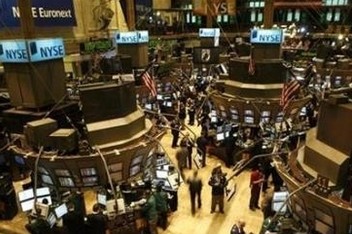
Mortgage lenders dropped after Thornburg Mortgage Inc. was downgraded by a Jefferies & Co. analyst and Countrywide Financial Corp. was reported to be under investigation by the government for securities fraud.
Then, Bear Stearns Cos. dropped as Moody's Investors Service downgraded a batch of Bear securities backed by Alt-A mortgages, which are home loans given to people lacking proof of income or with minor credit problems.
The slew of downbeat financial news overshadowed a strong February sales report from McDonald's Corp., and led restless investors to proceed cautiously ahead of big economic reports later in the week: Thursday's report on retail sales and Friday's report on consumer prices. Those two readings will give Wall Street a better idea of how much the average American is struggling with falling home values and rising costs, and how aggressively the Federal Reserve will need to act when it meets next week.
"The next three days, there aren't any set, big, market-moving reports," said Ryan Detrick, senior technical strategist at Schaeffer's Investment Research. "The economic data Thursday and Friday is going to be the last bit of news, the last showing, before seeing what the Fed will do on the 18th."
The Dow Jones industrial average fell 153.54, or 1.29 percent, to finish near the lows of the session at 11,740.15. It was the lowest close for the Dow since October 2006.
Broader stock indicators also retreated. The Standard & Poor's 500 index fell 20.00, or 1.55 percent, to 1,273.37, while the Nasdaq composite index fell 43.15, or 1.95 percent, to 2,169.34.
Government bond prices jumped as stocks weakened. The yield on the 10-year Treasury note, which moves opposite its price, fell to 3.46 percent from 3.54 percent late Friday.
Investors appeared to shrug off an upbeat report from the Commerce Department that said US wholesale inventories rose in January by 0.8 percent, more than expected, and that sales at US wholesalers rose 2.7 percent, their widest jump since March 2004.
Last week, increasing worries about the economy and the continuing fallout from the credit crisis pounded the stock market. The Dow ended down 3.04 percent, the S&P 500 index was off 2.80 percent, and the Nasdaq composite index closed with a loss of 2.60 percent.
Recent record-breaking surges in commodities prices have worried many investors about whether the Federal Reserve might hesitate to lower key rates by as much as they want -- at least a half percentage point. Over the past few months, policy makers have cited the staggering economy as a greater risk than inflation.
On Monday, crude oil soared to finish at a record, rising $2.75 to $107.90 a barrel on the New York Mercantile Exchange after setting a trading record of $108.21 during the session. It was the fifth record set in the last six sessions.
Gold fell, while the dollar traded mixed.
Even if rising commodities costs do not restrain the Fed from lowering rates further, the market remains unsure that rate cuts will be enough to keep the sagging economy out of recession. Of particular concern is the job market -- the Labor Department last Friday said the economy lost 63,000 jobs last month.
Early Monday, JPMorgan analysts slashed their year-end target for the S&P 500 index and earnings for S&P 500 companies, after the bank's chief economist said he believes a recession began in January.
The Russell 2000 index of smaller companies fell 16.14, or 2.45 percent, to 643.97.
Declining issues outnumbered advancers by about 5 to 1 on the New York Stock Exchange, where consolidated volume came to 4.15 billion shares compared with 4.44 billion shares traded Friday.
McDonald's, a Dow component, rose $1.53, or 2.9 percent, to $53.80.
Thornburg Mortgage sank $1.08, or 60 percent, to 71 cents, while Countrywide fell 71 cents, or 14 percent, to $4.36.
Bear Stearns fell $7.78, or 11.1 percent, to $62.30 on the Moody's move and also amid market rumors about a liquidity squeeze at the company. Bear Stearns said in a statement there was "absolutely no truth" to the rumors.
Most Asian markets sank Monday, some in response to Wall Street's losses last week, with Tokyo's market falling to a 2 1/2-year low. In Tokyo, the Nikkei 225 stock average tumbled 1.96 percent to its lowest point since September 2005.
Hong Kong's market bucked the trend, with a recovery in afternoon trading driven by bargain-hunting and gains at the bank HSBC. The Hang Seng Index rose 0.9 percent.
Stocks slipped on European exchanges. Britain's FTSE 100 fell 1.24 percent, Germany's DAX index fell 1.01 percent, and France's CAC-40 fell 1.13 percent.
|
|
|
||
|
||
|
|
|
|