|
|||||||||||


BEIJING - An extension of the Kyoto Protocol beyond its first commitment period ending in 2012 is of crucial importance to global efforts in addressing climate change, a World Wide Fund for Nature (WWF) official said Saturday.
For the world to continue its ongoing efforts against global warming, a seamless connection between the protocol's first and second periods is needed, said Hou Yanli, director of the Climate & Energy Programme of the WWF's Beijing Office, in an interview.
To avoid devastating consequences, countries across the globe have agreed to goals of restricting eventual global warming so that the planet is no more than two degrees Celsius hotter than pre-industrial levels and reducing global greenhouse gas emissions by 80 percent by 2050 from 1990 levels.
To make that possible, the Kyoto Protocol was signed in 1997. But the protocol, the only pact setting legal curbs on global emissions, is due to expire in December 2012.
"With Japan, Russia and Canada refusing to sign for a second commitment period, whether the protocol can be extended becomes a primary challenge for the upcoming Durban conference," said Hou, who will head for the conference next week.
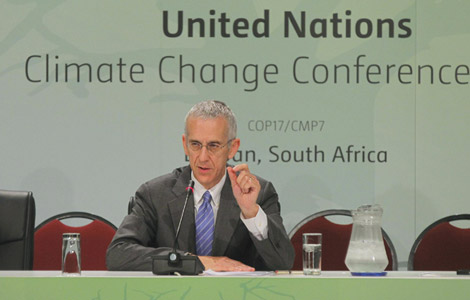
Delegates from nearly 200 governments will attend the climate talks in the South African city of Durban from November 28 to December 9.
Vital link
"This connection is vital to the United Nations' Clean Development Mechanism (CDM). If it fails, the weakened international political signal will shatter the confidence of enterprises worldwide in making emission reduction efforts," Hou said.
The CDM, which aims to create a worldwide carbon cap and trade system, was introduced by the protocol in 1997 and came into force in 2005. Under the mechanism, rich nations can invest in developing countries' green energy projects in return for carbon credit.
Meanwhile, the substantial implementation of policies making funding and technology available to help poorer nations develop low-emission efforts, also counts on the support of the protocol's continuation, Hou said.
"Developing economies, though responsible for a large share of global emissions, still have the need for development. Both capital and technology are important for them to grow low-carbon development," she said.
At the Cancun conference in 2010, industrial nations agreed to provide 30 billion U.S. dollars in fast-start funds between 2010 and 2012 and 100 billion U.S. dollars a year by 2020 to assist developing economies in tackling climate change. But the 30 billion commitment has not been met, partially due to sluggish growth in developed economies, according to Hou.
"Against the backdrop of the global financial turmoil, it's unrealistic for developed nations to raise all climate funds from public finance," Hou explained.
"To solve the issue, we suggest sources of international financial transaction tax, carbon trading and other special sectors such as aviation and shipping industries," she added.
Difficult talkss
From Bali to Copenhagen and Cancun, the international climate talks have been through ups and downs. The real obstacle for pushing forward global climate cooperation remains the lack of strong political will in some developed economies, Hou claimed.
"Following international agreements such as the United Nations Framework Convention on Climate Change (UNFCC) and the Bali Road Map, developing nations have been taking concrete measures in performing their obligations over the past few years," she said.
But despite these legally binding documents, few developed countries are meeting their commitments and making real progress in reducing emissions, except for the EU, according to Hou.
In contrast to the EU, a front-runner in emission reductions, the U.S., by constantly setting new conditions, fails to play a leading role as a world economic leader, Hou said, adding that empty promises have been made by the country since it signed the Kyoto Protocol but never ratified it.
"The climate talks should not be politicized. What's more important about the issue is development," Hou said.
"We hope that industrialized nations can take their historical responsibilities and come up with ambitious emission reduction targets at the Durban conference, while developing economies can make national action plans to drive growth through low-carbon development," she said.
China's role
China's rising as a global power on the world stage has made it an important force in driving global emission reduction efforts. Fundamental change has happened to the perception of the world's second-largest economy regarding the climate issue, as reflected by the recently released white paper on climate change, Hou said.
The white paper, "China's Policies and Actions for Addressing Climate Change", showed the nation's emission reduction efforts made in line of its obligations within international cooperation framework during its 11th Five-Year Plan Period (2006-2010).
The government and all its social sectors have acted in a way that shows their resolve in addressing the issue, Hou said.
"It takes courage for China, a country with such a huge population, to make the decision - to transform toward a low-carbon economy, and the change is starting to unfold in the country," Hou said.
As for the role China can play under the UNFCC in the future, Hou said the white paper has established the direction of green development for the country, beneficial to both its people and the international community.
But like other developing economies, the nation is in a fast development phase and faces vast challenges during its urbanization process. Thus, it should continue its low-emission policies and measures in the future, and work further with both developing and developed nations in sharing valuable experiences, Hou said.
"Furthermore, as it grows stronger, the country should render more support to other developing countries as well," she added.



Hot Topics
HIV/AIDS, Egypt protest, Thanksgiving, climate change, global economic recovery, home prices, high-speed railways, school bus safety, Libya situation, Weekly photos
Editor's Picks

|

|
|

|

|

|

