

Hawkish Japanese Prime Minister Shinzo Abe finally showed the cloven hoof. He celebrated the first anniversary of his second premiership by insulting Japan's neighbors and rest of the world.
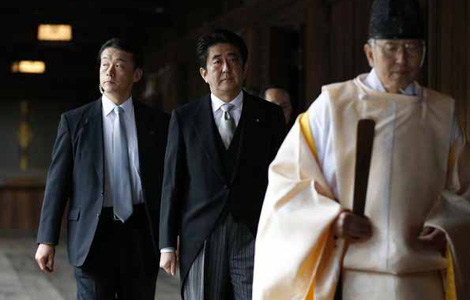
His visit to the Yasukuni Shrine on Thursday betrayed his decision to defile righteousness, conscience and truth.
His Yasukuni pilgrimage was a declaration of deliberate provocation. It is the first time in seven years that a sitting Japanese prime minister has visited the shrine. The previous one was former Japanese Prime Minister Junichiro Koizumi.
| Special report:China-Japan Relations |
He has chosen to throw down the gauntlet on the international documents settling Japan's wartime responsibilities during its colonization of some Asian countries and in World War II.
At the International Military Tribunal for the Far East, 28 Japanese leaders were charged with Class A crimes, and more than 5,700 with Classes B and C crimes. Fourteen of the Class A criminals, including the wartime Prime Minister Hideki Tojo, are enshrined at the Yasukuni, which makes the shrine a place that sensible politicians should not visit.
But Abe has chosen to salute his country's war criminals. He has pledged to boost patriotism among his countrymen in a way that plays down or denies Japan's war atrocities in WWII.
In its first-ever national security strategy, Abe's cabinet approved on Dec 17, spelled out the need for "promoting a feeling of love for one's nation and hometown."
The new national security strategy explains the latest push to promote patriotism by saying, "It will be indispensable to consider national security as an issue of close concern and have a deep recognition of its importance and complicated nature."
The inclusion also reflected a long-time personal initiative important to Abe. During his first stint as prime minister, he helped revise the Fundamental Law of Education by including, for the first time, wording that explained the importance of patriotism.
"It feels strange to include the issue of patriotism in a national strategy because it should be up to each person to decide whether they love their country. We don't know what the government means by 'love for the country' in the first place," Hiroshi Nishihara, a professor of constitutional law at Waseda University, was quoted by Kyodo News as saying.
"When a country tries to foster patriotism, it is often used as a tool to direct the energy toward achieving something outside, rather than inside the country," Nishihara said.
Still, Japan's school textbooks are part of Abe's education reform policy that includes adopting moral education and patriotism into school curricula.
Japan's education ministry is planning to implement school textbook reform to better reflect the Japanese government's stance on topics such as history and island disputes. Japanese Education Minister Hakubun Shimomura announced in November that the ministry will revise the textbook screening process for elementary, junior and high schools.
Shimomura and many high-ranking members in the Abe cabinet are dedicated to reforming history education for Japan's future.
Abe once headed the secretariat of a "group of young legislators dedicated to reforming history education for the nation's future," which has criticized descriptions about "comfort women" in school history textbooks for reflecting a "masochistic historical view." Comfort women were forced to provide sex for Japanese soldiers before and during World War II.
The group has also been calling for a review of the 1993 statement by Japan's former Chief Cabinet Secretary Yohei Kono. The statement acknowledged that the comfort women were coerced by the Imperial Japanese Army, and offered an apology expressing Japan's remorse over the issue.
Also, there are Japanese officials who urge Abe to review the Murayama statement, the only cabinet-approved apology by Japan. The statement issued in 1995 by then-Prime Minister Tomiichi Murayama acknowledges that Japan caused "tremendous damage and suffering to the people of many countries, particularly to those of Asian nations" during its colonial rule of specific countries. Murayama also expressed the country's "deep remorse" and "heartfelt apology" to the victims.
Abe acknowledges that the portion of the statement that refers to the damage caused by Japan in Asia but disregards the references to colonial rule and aggression. "Aggression," he said, was a term that had not yet been defined academically and internationally, and as a politician he would not pry into such debates.
Murayama has warned that reviewing the war apology would only lead Japan to isolation.
In the first year of his second premiership, Abe has played up the severity of the security threats facing Japan so his administration could push nationalism in the name of patriotism and boost military buildup.
|
|
|
|
|
|
|
|

Copyright 1995 - . All rights reserved. The content (including but not limited to text, photo, multimedia information, etc) published in this site belongs to China Daily Information Co (CDIC). Without written authorization from CDIC, such content shall not be republished or used in any form. Note: Browsers with 1024*768 or higher resolution are suggested for this site.
License for publishing multimedia online 0108263 Registration Number: 20100000002731 

















 Op Rana
 Berlin Fang
 Zhu Yuan
 Huang Xiangyang
 Chen Weihua
 Liu Shinan