Income inequality was a major topic at this year's annual World Economic Forum at the Swiss ski resort of Davos. That problem seems to be as acute in the world's two largest economies of the United States and China as in other parts of the world...
A report by Oxfam, an international confederation of 17 organizations to find solutions to poverty in the world, showed that by 2016, the top 1 percent of the world's population could own more wealth than the other 99 percent combined if the current trend of rising inequality continues.
Such a warning coincides with the outcry of the Occupy movement that swept cities in the US and several other countries three years ago about the injustice caused by the excessively powerful and wealthy 1 percent in their societies.
The Oxfam study published Jan 20 showed that the richest 1 percent have seen their share of global wealth increase to 48 percent in 2014 from 44 percent in 2009. This very global elite had an average wealth of $2.7 million per adult in 2014.
And even of the remaining 52 percent of the global wealth, almost all (46 percent) is held by the rest of the richest 20 percent of the world's population. The other 80 percent share just 5.5 percent and had an average wealth of $3,851 per adult, or 1/700 of the average wealth of the top 1 percent, according to Oxfam.
"Do we really want to live in a world where 1 percent own more than the rest of us combined,"said Winnie Byanyima, Oxfam International's executive director who co-chaired this year's Davos summit, which concluded on Jan 24.
"In the past 12 months we have seen world leaders from President Obama to Christine Lagarde talk more about tackling extreme inequality but we are still waiting for many of them to walk the walk. It is time our leaders took on the powerful vested interests that stand in the way of a fairer and more prosperous world,"Byanyima said.
While Obama in his State of the Union address last week asked, "Will we accept an economy where only a few of us do spectacularly well? Or will we commit ourselves to an economy that generates rising incomes and chances for everyone who makes the effort?”, income inequality in the US has actually worsened under Obama's six years in office when the bottom 99 percent saw their income stagnate.
A Pew Center survey released last year found that the majorities in the 44 nations polled described the gap between the rich and the poor as a big problem for their country.
While the problem looked extremely serious in Africa and some European nations hit by the current recession, such as Greece, Spain and Italy, it was a big problem in the US for 89 percent of Democrats, 77 percent of Independents and 60 percent of Republicans in the Pew's spring 2014 poll.
In China the income inequality has also become a key issue while the country enjoyed rapid economic growth for more than three decades to become the world's second largest economy.
The report from China's National Bureau of Statistics on Jan 20 showed that the Gini co-efficient, widely used as a measure for inequality, stood at 0.460 in 2014. The Gini co-efficient ranges from 0, which represents perfect equality, to 1, for absolute inequality.
While the figure for China has continued to drop for the six consecutive years, suggesting an actual improvement, it is still much worse than the 0.40 warning level set by the United Nations. This was against the backdrop that China was very much an egalitarian society before the country reformed and opened up its centrally planned economy in 1978.
The Chinese government started to announce the Gini co-efficient in 2000 and the index reached its worst of 0.491 in 2008.
Huge income disparity aside, a study by the Peking University last July showed that the top 1 percent of Chinese families owned one-third of the nation's wealth in 2012 while the bottom 25 percent had only about 1 percent.
Most Chinese experts believe that while China's transition from a planned economy to a market-oriented economy has unleashed decades of rapid economic growth, it has also created unfair opportunities for different sectors of society, an unfair distribution of resources and plenty of rent-seeking activities for officials who abuse their power.
This is especially true in certain industries where state monopoly is prevalent, such as in telecom, energy and financial sectors.
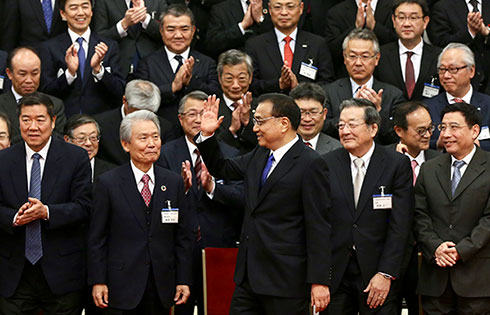
In Davos on Jan 21, Chinese Premier Li Keqiang vowed to improve the income distribution and well-being of his people. He admitted that requires "painstaking efforts,"but he declared "we won't be deterred."
Contact the writer at chenweihua@chinadailyusa.com
 When it comes to Africa, China's inroads are just getting started
When it comes to Africa, China's inroads are just getting started

Copyright 1995 - . All rights reserved. The content (including but not limited to text, photo, multimedia information, etc) published in this site belongs to China Daily Information Co (CDIC). Without written authorization from CDIC, such content shall not be republished or used in any form. Note: Browsers with 1024*768 or higher resolution are suggested for this site.
License for publishing multimedia online 0108263 Registration Number: 130349