 |
|
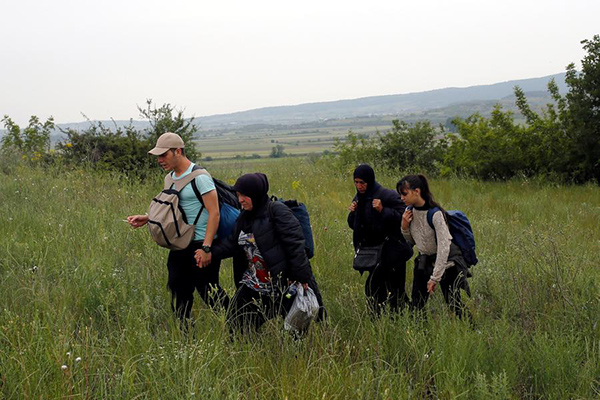
A group of migrants and refugees who stayed in Idomeni makeshift camp walks through a field in attempt to cross the Greek-Macedonian border near the village of Evzoni, Greece, May 12, 2016. [Photo/Agencies] |
LONDON - As the refugee crisis was unfolding in Europe last year, the social impact team at professional networking site LinkedIn had an idea: why not use its expertise to connect the new arrivals with companies willing to employ them?
Early this year, LinkedIn launched "Welcome talent", a micro-site in English and Arabic that puts migrants to Sweden - which took in 163,000 asylum seekers in 2015 - in touch with local companies offering internships and jobs.
The Silicon Valley tech firm is exploring the potential to expand the pilot project, which advertizes some 400 jobs, and says it was not a one-off.
Using its assets of data and human capital, LinkedIn has also taken up a matchmaking role in connecting experts with organisations involved in response to disasters such as earthquakes, when the need for professionals peaks.
"We're really focused on using what LinkedIn is already good at," said Maryam Ghofraniha, the company's head of global partnerships.
"We can't respond to every single disaster that takes place every day and we're likely to get involved where LinkedIn's core strength is going to make an impact."
How technology can be put to better use to improve crisis response will be a key theme at the World Humanitarian Summit in Istanbul next week, where a Global Alliance for Humanitarian Innovation will be launched.
LinkedIn is not the only company in the technology sector offering its business strengths in support of emergency aid.
In 2013, apartment-letting website Airbnb launched a tool allowing its hosts to offer free accommodation to disaster survivors and people aiding them. It was recently used to help those affected by April's earthquakes in Japan and Ecuador.
"We try to activate it within the first 24 to 72 hours of an event," said Kellie Bentz, Airbnb's head of global disaster relief. "We're still working through our process because we basically want enhancements to the product."
AID WORKERS AND TECH ENTREPRENEURS
The tech sector's push to improve and innovate attracted the attention of the UN Office for the Coordination of Humanitarian Affairs (OCHA).
"We are serving people but coming from a different angle," Alexandra Sicotte-Levesque, OCHA's global adviser on community engagement, told the Thomson Reuters Foundation.
Often aid agencies approach the people they help as recipients rather than customers. "So I think we have a lot to learn from the private sector," she added.
While aid workers and tech entrepreneurs often don't speak the same language, OCHA hopes that collaborating with Silicon Valley high-flyers will bring something new to the way humanitarians operate: an open mindset that delivers what people really need when a crisis hits.
A year ago, OCHA and other UN agencies talked to between 25 and 30 tech companies, including Airbnb, LinkedIn, Twitter, Facebook and Google. The consultations resulted in the creation of an informal group to determine how they could best team up to improve disaster response.
Now both sides must learn more about how the other works, said Sicotte-Levesque.
Not all tech companies' innovations are suited to difficult settings with poor phone and internet coverage, she said.
"Humanitarian response sometimes is ... low-tech," Sicotte-Levesque said. "We need to think much more strategically about what they can bring to the response."
But the technology sector is quick to adapt. This week San Francisco-based tech firm Open Garden - which has collaborated with OCHA - will launch an emergency alerting service that enables organisations to reach people on their smartphones even when cellular networks and internet access are unavailable.
FireChat Alerts acts as a peer-to-peer broadcasting system, delivering text and visual information including early warnings, emergency and health advisories, and weather and traffic information to those with the messaging app on their phones.
CHANGING NEEDS
When relief giant CARE International started operating after World War Two, the aid packages it sent to Europe contained food and blankets. Now it provides other essentials for war-hit Syrians on the move: mobile phone charging and wi-fi points.
"That is what the refugees need and want; that is the modern age - technology is everywhere," Laurie Lee, chief executive of CARE's UK arm, told the Thomson Reuters Foundation.
Former UN aid chief John Holmes urged the humanitarian sector to make better use of information technology - including recruiting volunteers to create customised apps "which could really start to fix some of our problems".
"The (aid) system is heavily over-stretched - always lurching from one crisis to another, and therefore doesn't really have the capacity to do enough of that," he said.
"But it needs to - otherwise we will be left behind by those things," he warned.

Copyright 1995 - . All rights reserved. The content (including but not limited to text, photo, multimedia information, etc) published in this site belongs to China Daily Information Co (CDIC). Without written authorization from CDIC, such content shall not be republished or used in any form. Note: Browsers with 1024*768 or higher resolution are suggested for this site.
License for publishing multimedia online 0108263 Registration Number: 130349