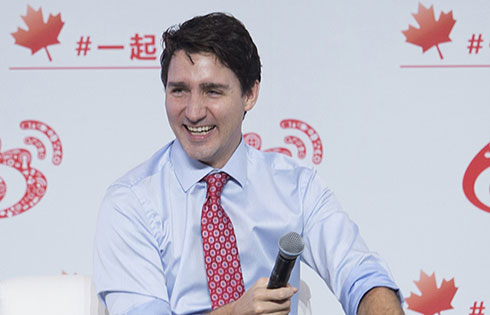
Gao Min shows her work at a gingerbread decorating event at Leeds University's British-born Chinese Society. [DAVID YU/FOR CHINA DAILY]
Thousands of British-born Chinese, or BBCs, face questions almost every day about their backgrounds.

They also deal with the challenge of forging personal identities in a country where many people will initially presume that they are visitors.
Britain is home to more than 433,000 Chinese, according to the 2011 census, with about a third of them born in the UK. They often find themselves caught between two cultures.
Clumsy questions such as “But where are you really from?” are familiar to BBCs. At home with their families, they may encounter different challenges, often raised by parents who are unaccustomed to British social norms and habits that their children have assumed as second nature.
British-born Guo Jinjin, a 20-year-old medical student at Leeds University whose parents moved to the UK from Nanjing, Jiangsu province, said, “When I first found a boyfriend and I was invited to his house, my parents didn’t feel comfortable.
“When my parents were younger back in China, they didn’t go to the opposite sex’s house alone.”
Tackling cultural duality has an impact on well-being among BBCs, according to Heung Chingchu, who conducted a study at the University of London on the development of their ethnic self-identity.
Heung found there was positive correlation between feeling comfortable with growing up among two cultures and self-esteem.
Anna Chen, a British writer whose father comes from Guangdong province, said that even the term “BBC” does not appropriately describe her identity.
“I want to change this to Chinese Britons, because I think British has to be at the core of the term,” Chen said. “This is how I see myself, as a Chinese Brit, because I was born and raised in Hackney.”
Guo Jinjin, vice president of Leeds University’s British-born Chinese Society, said that since the European Union referendum was held in June, she had noticed an upturn in verbal abuse from white Britons.
“Someone will drive by in a car and shout stuff at you like ‘go back to your own country’ or ‘chinky’,” she said.
What is clear is that ethnic Chinese work hard at school and that many succeed in the workplace — up to a certain point.
In 2010, researchers at Bristol University found that Chinese students in British schools gained more top grades than their white British counterparts in every General Certificate of Secondary Education subject.
In the same year, the National Equality Panel found that a fifth of Chinese men were employed at management level, a higher rate than all other major ethnic groups in the UK.
However, Chinese women experienced a wider gender pay gap than other ethnic groups in Britain despite having higher qualifications.
In 2009, researchers at the University of York found Chinese in Britain were strongly represented in the service and hospitality industries, in medical and veterinary jobs, and in the retail and construction sectors.
But Chinese are underrepresented in certain jobs with high public profiles.
British-Chinese actress Elizabeth Chan wrote in The Guardian, “Although we are the fourth-largest minority ethnic group in the UK, we are virtually invisible in public life – principally the arts, media and politics.”
The Chinese community in the UK is more diffuse than most ethnic groups. Many families working in the service industry in rural areas are the only Chinese in their communities.
Guo’s family moved to a village outside Lincoln, where she was the only Chinese girl at her secondary school.
“There was some teasing from the other kids,” she said. “When I moved to Leeds, I had a lot of people asking me, ‘Where are you from?’ I’d say Lincoln, and they’d look at me like, ‘no, you’re not’.”
Guo said that for much of her youth she felt a strong desire to suppress the differences she had with her classmates, and didn’t feel she belonged in either the UK or China.
“When I’m in China I feel more British, because of the differences in the way I grew up,” she said. “When I’m in Britain I feel more Chinese, because I look different.”
For Guo, celebrating her differences came with age. She now feels that she is able to use the access she has to two cultures to her advantage.
“Chinese culture has become a bigger part of my life,” she said. “I’ve embraced the fact that I am different. I get to experience British culture and Chinese culture and I think I am a better person for it.”
angus@mail.chinadailyuk.com

Copyright 1995 - . All rights reserved. The content (including but not limited to text, photo, multimedia information, etc) published in this site belongs to China Daily Information Co (CDIC). Without written authorization from CDIC, such content shall not be republished or used in any form. Note: Browsers with 1024*768 or higher resolution are suggested for this site.
License for publishing multimedia online 0108263 Registration Number: 130349