Belt and Road offers tangible benefits









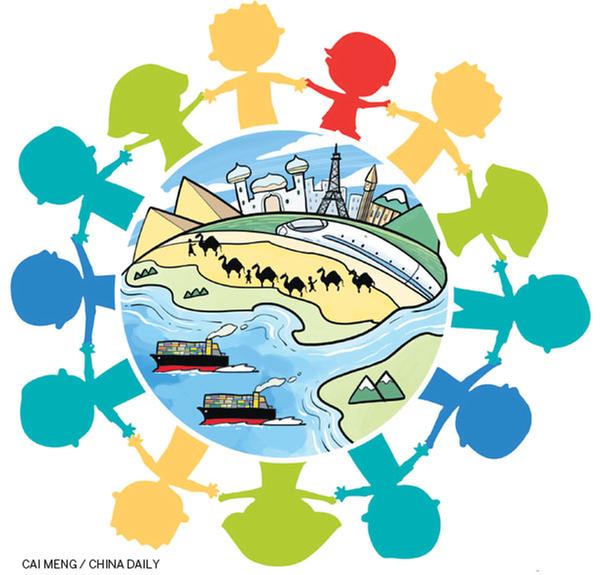
Editor's note: Four researchers share their views with China Daily's Cui Shoufeng on what the provinces and regions in western China should do to better integrate into and benefit from the Belt and Road Initiative, which comprises the Silk Road Economic Belt and 21st Century Maritime Silk Road. Excerpts follow:

Western region should also enjoy the fruits
Zhao Lei, a professor at the Party School of the Communist Party of China Central Committee
The Silk Road Economic Belt could bring tangible benefits to western China and the people who live there. But that must not come at the cost of undermining the already fragile ecology in the western region. In other words, local governments have to make extra efforts to reduce the side effects of exploitation and transportation of energy, keep at bay outdated and pollution-prone industries, and focus on the modern service industry such as cultural tourism.
Building a mature, radiated economic zone on the basis of major transportation routes, too, is necessary. The lack of westward routes has added to China's cost of trading with Central Asian countries, highlighting the need for developed modern industrial clusters that pivot on provincial capitals and thrive on advanced road infrastructure.
At the forefront of the Silk Road Economic Belt is mostly the less-developed western region where talents in international trade and global market are in short supply. To boost cross-border exchanges between western China and the economies along the Belt and Road routes, the region will require sufficient intellectual support. It will also have to take into account the complexity of ethnic and religious issues in the region.
To help western China, which has more than 80 percent of the country's minority ethnic groups and the longest land border, to enjoy the fruits of the Belt and Road Initiative, the government has to further secure its western borders and ensure benign integration between different ethnic groups. And that bottom line should never be crossed to expedite transnational cooperation.

Need to strengthen 'soft' connectivity
Xi Huidong, an associate professor at the Institute of Silk Road Studies, Northwest University
As a growth pole in northwestern China, Shaanxi province is striving to become an inland linchpin of the Belt and Road Initiative, which has pushed landlocked western China to the forefront of the "go global" reform. Its ambition emanates from its role as a trade and logistics pivot linking China with Central Asia, even Western Europe-a technological innovation hub and a cultural tourism center.
The international freight train Chang'an, which made its maiden run to Central Asia in November 2013, now travels up to Rotterdam, a seaport in the Netherlands.
Home to a number of leading universities and research institutes, Shaanxi has a versatile, complete industrial system, whose aerospace, energy and telecommunications sectors are well known nationwide. That allows the province to work closely with some resource-rich Central Asian countries in terms of exploration of resources.
Shaanxi is also home to a slew of cultural heritages related to the ancient Silk Road, giving it a unique advantage in boosting cultural, academic and people-to-people exchanges with Central Asian communities.
But since the province does not have enough scholars who specialize in South Asian and Southeast Asian studies, particularly with regard to issues related to customs and resources, in the economies along the Belt and Road routes, enterprises that have managed to "go global" often struggle to proceed with their projects for the lack of knowledge about local laws and regulations, as well as the endorsement of Shaanxi authorities. Besides, not many Shaanxi residents choose Central Asian destinations to spend their holidays. So, extra efforts must be made to strengthen the province's "soft" connectivity with the economies along the Belt and Road routes.