Mutual trust can improve China-India ties









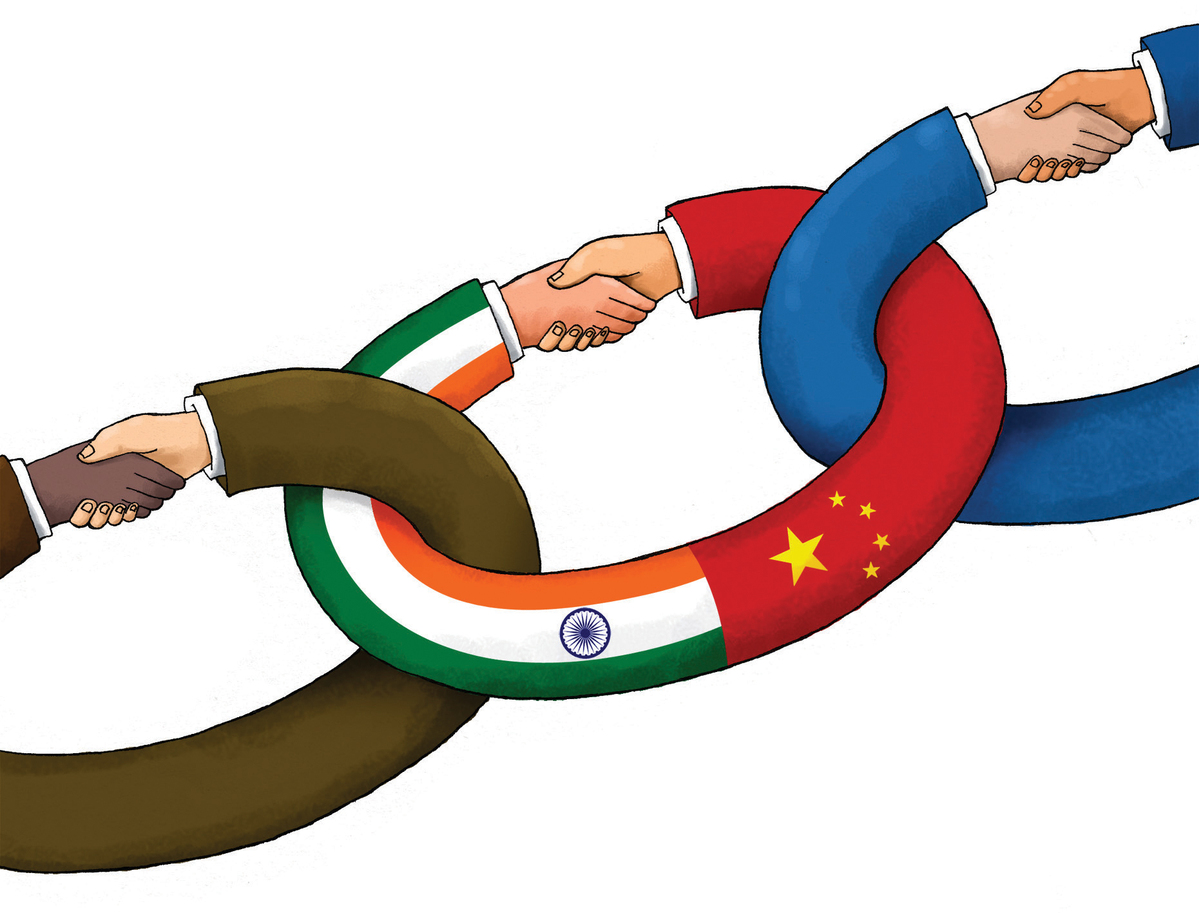
Editor's Note: The "informal" summit between President Xi Jinping and Indian Prime Minister Narendra Modi in Wuhan, Hubei province, on April 27-28 signaled a positive phase in Sino-Indian ties. And Modi's scheduled participation in the Shanghai Cooperation Organization Summit in Qingdao, Shandong province, in June, where he is again likely to meet with Xi, is expected to take this momentum forward. Two experts share their views on China-India ties with China Daily's Pan Yixuan. Excerpts follow:
Promote cooperation to improve relations
The lack of mutual trust between China and India has prevented bilateral ties from deepening, even though the two sides' common interests far outweigh their differences.
Some unresolved bilateral issues have been left over by history, such as the border dispute that led to the Donglang (Doklam) standoff last year. And some new disagreements have emerged between the two neighbors, including the one on the China-proposed Belt and Road Initiative, which India views as an "expansionary move". As a result, India gave the nod to the United States-initiated "Indo-Pacific" strategy, which many say is aimed at hindering China's development.
But India and China have similar views on issues such as globalization and similar needs for national rejuvenation, and are willing to cooperate on such issues. This means the prospects of deepening China-India cooperation are high.
The current bilateral trade volume is incommensurate with the status of China and India as the largest developing countries and the second-and sixth-largest economies. For example, they can deepen cooperation on environmental management and resource development to increase their trade volume.
Besides, inadequate cooperation does not mean there is no cooperation between the two sides. Although India is averse to joining the Belt and Road Initiative, Beijing and New Delhi are members of BRICS, G20 and the Shanghai Cooperation Organization, and the two sides have been making joint efforts to resolve many global issues.
To deepen cooperation, China and India first need to strengthen bilateral communication, including high-level talks, to seek common ground while shelving their differences.
The two sides should also deepen cooperation in regional and global economic, environmental and security issues. And instead of ignoring their disagreements, they should continuously hold talks to reach more agreements.
Sun Shihai, head of the Institute of South Asian Studies, Sichuan University
'Informal' summit to give right direction
The "informal" summit between Xi and Modi may help China and India to broaden their pragmatic cooperation. India and China are not only the largest developing countries but also home to one-third of the world's population. So they have to boost their economic development in order to improve their peoples' livelihoods and living conditions.
And amid the disputes between globalization and protectionism, and regional and global conflicts, China and India have several common interests: they support globalization, want to promote regional and global peace, and are fighting terrorism.
Given these facts, China and India need to make greater efforts to increase mutual strategic trust.
India has adopted a policy of balancing its interests, for which it is improving relations with the US, the European Union, Japan and Southeast Asian countries. India is not likely to change this policy, and will continue to cooperate with the US, Japan and Australia to build a quadrilateral power arrangement in the "Indo-Pacific".
But at the same time, given the importance of Sino-Indian ties for New Delhi, it is not likely to take measures that would harm China's interests or compromise mutual benefit.
The meeting between Xi and Modi may guide the China-India relationship toward a clearer direction to carry out pragmatic cooperation in many fields in the future, and contribute to regional stability and development.
Moreover, the two sides should embrace competitiveness with an objective mind, instead of resorting to zero-sum games. They also should respect each other's moves to cooperate with other countries, for instance, India's cooperation with the US, Australia and Japan in the "Indo-Pacific" and China's cooperation with Pakistan to widen the scope of the Belt and Road Initiative.
Zhou Gang, former Chinese ambassador to India