Patriotism the soul of national image










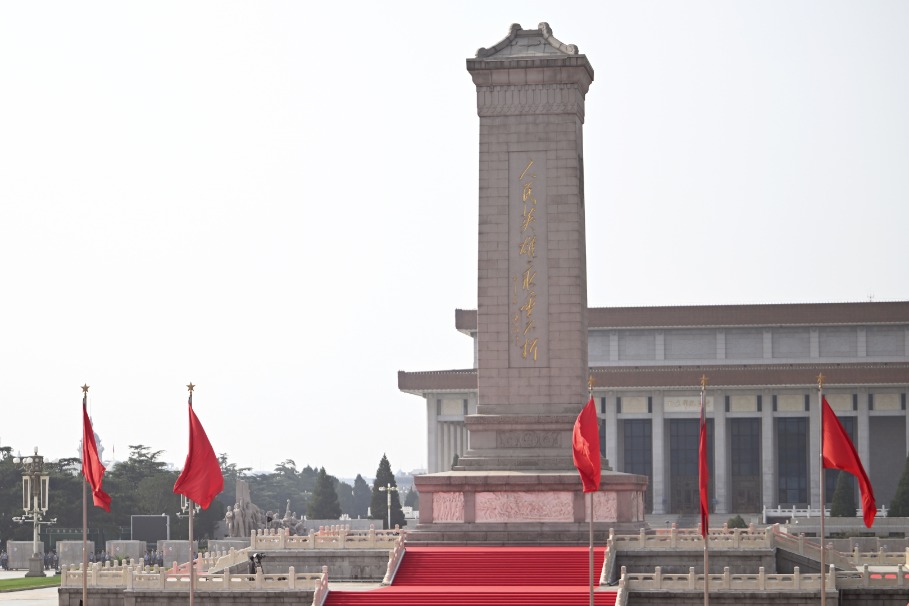
Sept 30 marks Martyrs' Day. As usual, the Chinese leadership, along with representatives from various sectors, has gathered at Tian'anmen Square to lay wreaths in honor of the people's heroes. This ceremony is not only important for showing respect for the sacrifices of the martyrs but also vital for fostering patriotism among the Chinese people.
This year, which marks the 80th anniversary of the victory in the Chinese People's War of Resistance Against Japanese Aggression (1931-45) and the World Anti-Fascist War, has seen the special organization of artistic works and cultural tourism projects to commemorate the occasion. While the film, Dead to Rights, has been well-received by audiences, "red tourism sites" (mostly related to the historical sites of the revolutionary era) across the country have gained in popularity due to the growing sense of patriotism among the Chinese people.
In recent years, festive celebrations have increasingly highlighted the importance of national consciousness and patriotism. During this National Day holiday week, for instance, national symbols are being prominently displayed across the country, sparking different interpretations, from respect for patriotism to misconceptions, by different countries.
Rising patriotism reflects a greater sense of identity among the Chinese people. In its effort to achieve national rejuvenation, China is putting special emphasis on the historical narrative and national identity, which are manifested in the country's national image.
Countries worldwide have prioritized shaping their national image in the new media landscape. A country's image is shaped by both global perceptions and people's expression of their identity, which includes a country's values, historical memory and narratives. In particular, this is reflected in the vision put forward by President Xi Jinping to showcase the image of China as a trustworthy, loveable and admirable country in the new era.
A country's image is built first and foremost on reverence for its own history and shared values. Following the collapse of the Qing Dynasty (1644-1911), China embarked on a half-century journey of rebuilding the Chinese nation. Through struggles against imperialism, feudalism and bureaucrat-capitalism before the founding of the People's Republic of China in 1949, the Chinese people forged a clearer national identity. During this process, China suffered greatly in the two world wars, which made it better appreciate independence and sovereignty.
Many of today's red tourism sites, in essence, represent those historical memories. When I asked one of my students what was the most important lesson he had learned from over a decade of patriotic education, he said: "Peace. A world without war is the best world."
Following the founding of the People's Republic of China, the country began to fully exercise its sovereignty, build a modern state and shape its national identity. The unique historical awareness inherent to a nation, combined with the narrative of struggle for national liberation, needs to be more accurately reflected in education, culture and international communication, so as to help the world better understand China's contributions to global development.
When we refer to "red China", we also refer to a century of struggle by the Chinese people. Red is a symbolic representation; what hold greater significance are the historical memories and narratives of perseverance that the color red represents.
Without the correct understanding of 20th century history, the world risks descending into chaos, marked by populism and anarchism.
China's patriotic education represents both the values of its historical narrative and contribution to universal human values. By honoring their national heroes, people help their country to assume shared responsibilities for humanity's development and provide vital global public goods. The Chinese people can easily understand the differences between civilizations, sympathize with the vulnerable, oppose power politics and uphold justice.
Consequently, China's narrative of patriotism is invaluable; it signifies humanity's concern for the planet and deep respect for collective memory. Such national memories are genuine and complete, not crafted or packaged by individual political figures, but rather inherited by the Chinese people through cultural and educational continuity. Otherwise, why should the Chinese people be moved to tears watching films like Dead to Rights, wave the national flag on Tian'anmen Square or share their family stories with foreigners?
By understanding the historical memory and national identity of the Chinese people, one can also understand China's domestic and foreign policies, and realize that the vision of a community with a shared future for humanity indeed stems from the common values that emerged from China's own historical experience.
Narrating China's patriotism and connecting it with the shared global development goals has become essential for China's global communication. Building a community with a shared future for humanity, strengthening security, promoting development, upholding civilizational legacy, and improving governance are at the core of China's development philosophy.
In other words, patriotism is the soul of global security and development, and the most important common language for exchanges and mutual learning among civilizations.
The author is a professor at the School of Journalism and Communication, Tsinghua University.
The views don't necessarily represent those of China Daily.
If you have a specific expertise, or would like to share your thought about our stories, then send us your writings at opinion@chinadaily.com.cn, and comment@chinadaily.com.cn.