New strategy to promote sustainable growth









The Fifth Plenary Session of the 19th Communist Party of China Central Committee that concluded on Thursday laid out a comprehensive guideline for the 14th Five-Year Plan (2021-25), which covers virtually every aspect of China's socioeconomic life. Among them, several are targeted at advancing new developments.
As is being widely discussed, the plenum proposed the "dual circulation" development pattern as one of the key components of a new development framework. Also, new strategies for urbanization, cleaner production, and a more equitable distribution of public services have been laid out. The common thread in the guideline is to strengthen the domestic economy (or "internal circulation").
Over the last 30 years, the Chinese economy has integrated with the global economy. Yet the changing international environments have prompted China to shift the focus to the domestic economy.
China's share in global trade has increased since April this year, proving wrong the so-called experts' prediction of de-Sinification of the global economy. Despite this, the United States has intensified its efforts to decouple with China in the technology field, in a bid to curb, even stop China's technological advancement.
The US' moves against Chinese enterprises have had some negative effects. Chinese telecommunications giant Huawei has lost most of its supply sources of high-precision chips, and if the US ban continues into 2021, it may have to stop its production of high-end smartphones.
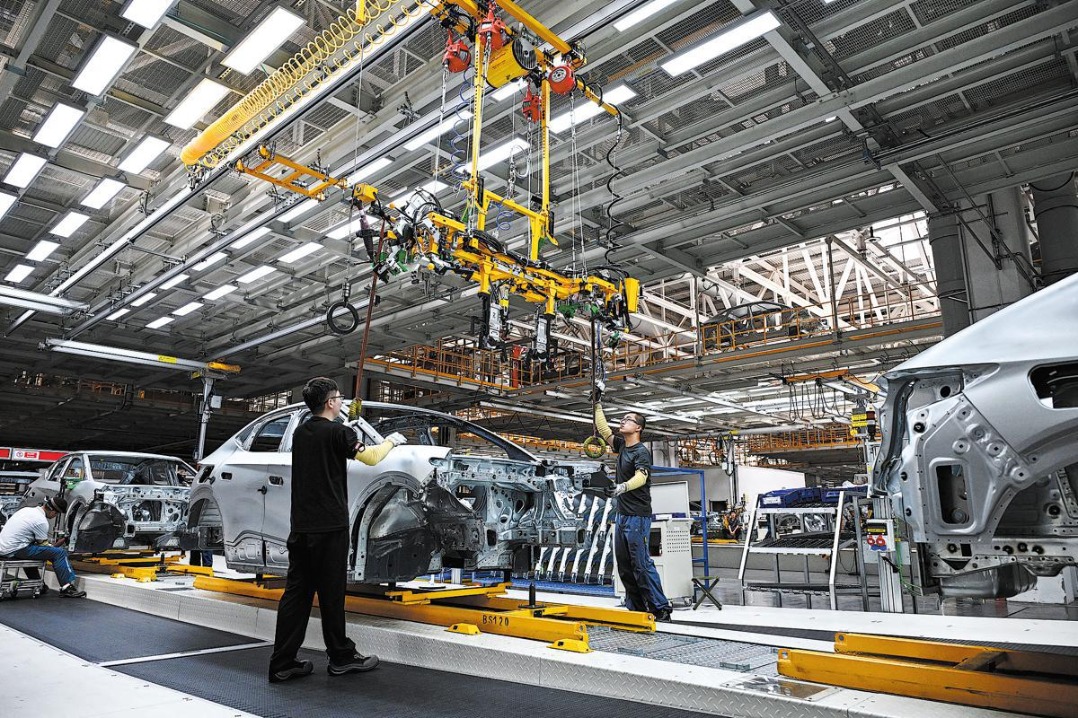
Against this backdrop, building technologies domestically in key areas has become a priority for China. One of these areas is the chip industry. And the government's aim is to increase the share of Chinese-made chips from the current 25 percent to 70 percent in five years.
While the US controls technologies for high-precision chips, China has the capability and capacity to increase its production of low-precision chips. In fact, the bulk of industrial demand is for low-precision chips-those of 40 nanometer or above account for nearly 80 percent of the total demand for chips.
China has already increased investment in the chips industry over the last few years. And the US ban will accelerate this process.
In addition to government support, China has the added advantage of being a large country with a huge market. Of course, China will have to incur higher costs in making the chips compared with purchasing them from other countries. But US chip-making companies will also lose a huge market, which will greatly hamper their innovation capacity. The US seems to be employing the "Tonya Hardin strategy"-risking one's own suicide in a bid to destroy the competitor, which, in this case, is China.
China's new strategy to become self-dependent in technology will be buttressed by the other strategies proposed by the plenum to boost the domestic economy. For instance, a new wave of urbanization will greatly boost domestic consumption and investment that are linked to sophisticated technologies such as 5G.
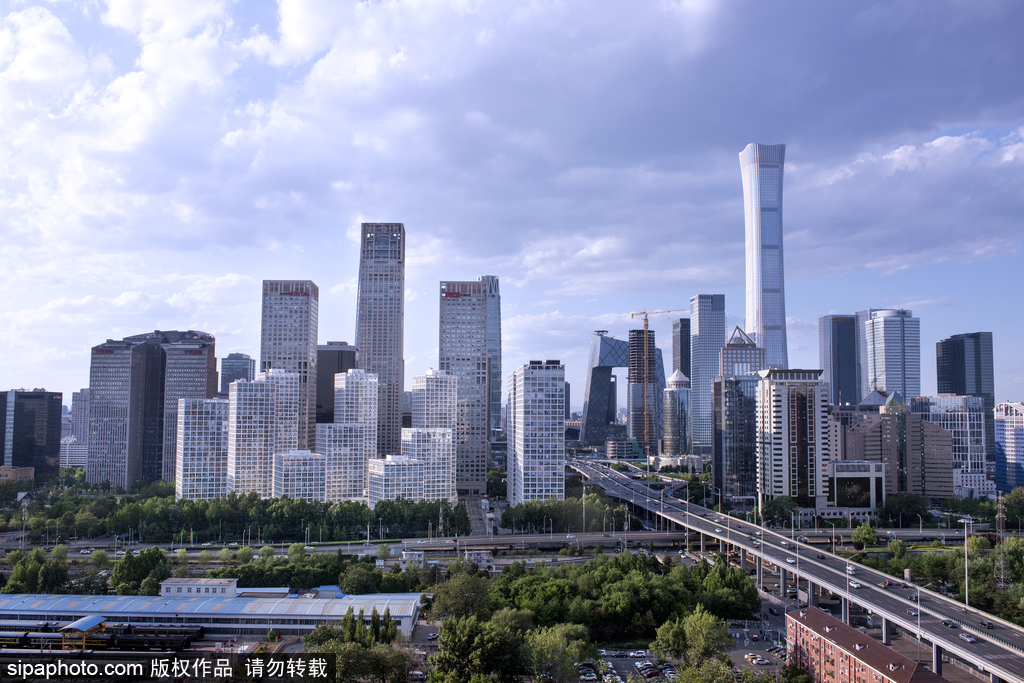
About 62 percent of China's population lives in cities today. Yet when Japan and the Republic of Korea had per capita GDP similar to that of China today, about 72 percent of their populations were urban residents. So it is possible that in the next 15 years, 75-80 percent of Chinese people will be living in cities, most of them concentrated in a few urban areas including the Pearl River and Yangtze River delta regions.
Besides, public goods will be more equally distributed across all income groups and regions in the years ahead.
At present, the pension and healthcare systems are separate, and large regional and urban-rural disparities exist. As such, more efforts need to be made to build a unified pension and healthcare system to facilitate freer mobility of labor across provinces and regions.
Putting more emphasis on the domestic economy, however, does not mean China will withdraw from the global economy (or "external circulation"). As the plenum said, China will further open up its economy to the outside world.
China will also shoulder more international responsibilities. One of them, as President Xi Jinping declared while addressing the recent United Nations General Assembly session, is to peak China's carbon emission before 2030 and become carbon neutral by 2060. This is a challenging task because accelerated urbanization means more energy consumption in the near future.
The only way for China to realize the two goals is by becoming more energy efficient and increasing the share of renewables in its total energy mix. Government agencies have already taken measures in that direction by rolling out plans for carbon trading and green finance. And with its industrial structure undergoing a major shift toward greener production, China will take its technological progress to a new level.
The author, a Cheung-Kong scholar, is the dean of the National School of Development, Peking University. The views don't necessarily represent those of China Daily.